Motion, Rotation, and an Unexpected Problem
When we observe the universe, nothing appears to be truly at rest. From the smallest particles to the largest cosmic structures, everything is in motion. Lighter objects tend to move more easily, while heavier ones appear slower and more inert.
Yet rotation does not follow this simple intuition. Angular momentum behaves like a form of energy that is almost universally present, even though it is not considered a fundamental force. Nearly every object in the universe rotates in some way.
This leads to a deeper question.
If massive structures rotate too fast, why are they not torn apart?
Galaxies That Rotate Too Fast to Exist
The first clear sign of this problem appeared in the 1930s, when Fritz Zwicky studied the Coma Cluster, located roughly 320 million light-years away. He found that galaxies in the cluster were moving far too fast.
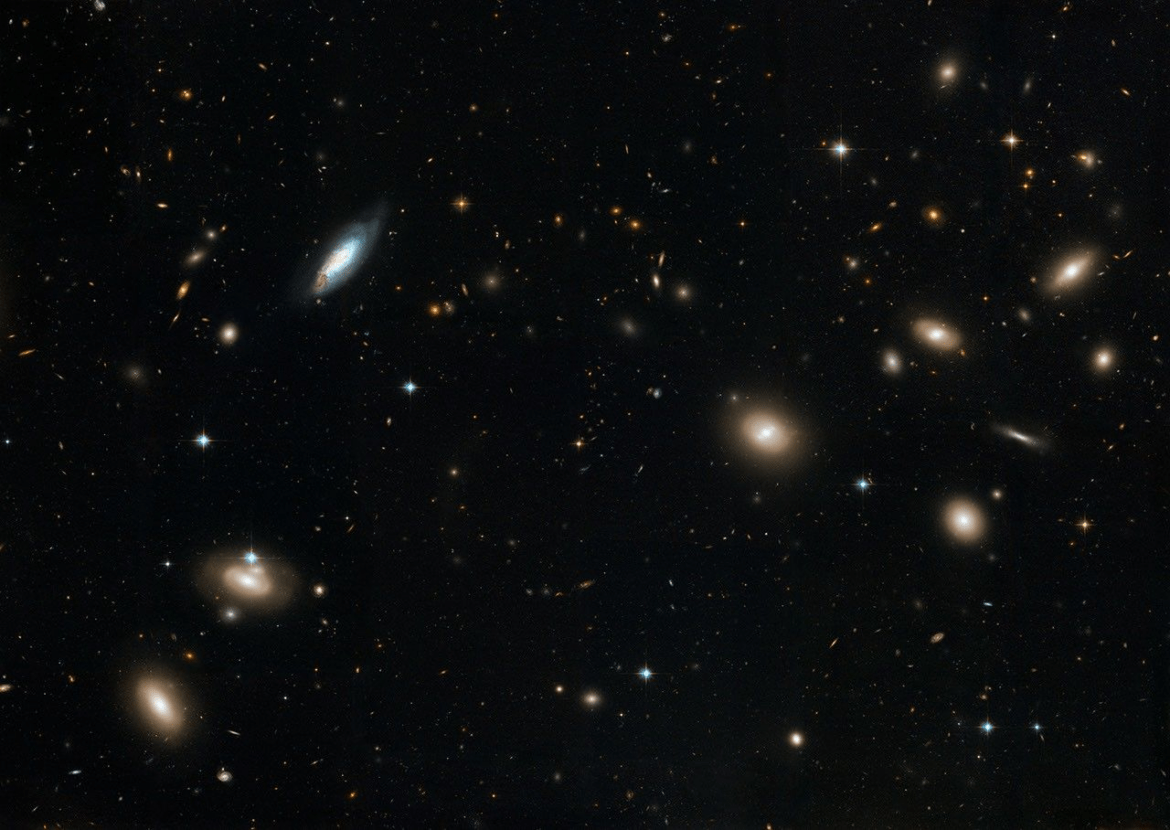
Based on visible matter alone, the total gravitational pull of the cluster should not be strong enough to keep it bound. The galaxies should have escaped long ago.
Later observations confirmed that this was not an isolated case.
Galaxy clusters across the universe showed the same behavior.
If angular momentum dominates gravity, these systems should collapse or disperse.
But they remain intact.
Flat Rotation Curves and a Missing Mass
As observational techniques improved, astronomers began measuring not only how fast galaxies move, but how fast they rotate internally. Individual stars were tracked at different distances from galactic centers.
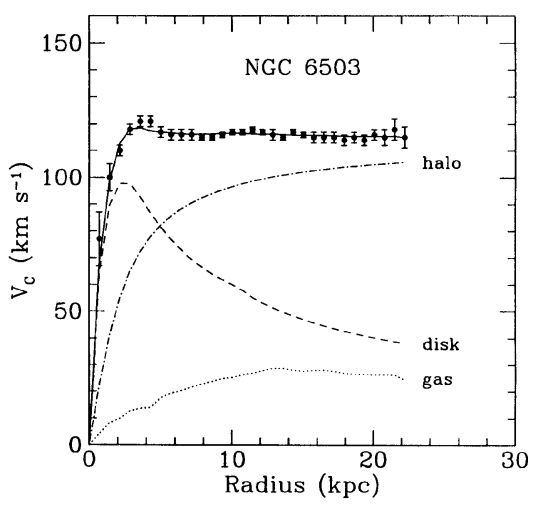
If galaxies behaved like the Solar System, stars closer to the center would orbit faster, while those farther out would slow down.
Instead, something surprising emerged.
Stars near the center and stars at the outer edges of galaxies orbit at nearly the same speed.
This result, confirmed in the 1970s, directly contradicted expectations based on visible matter.
The implication was unavoidable.
There had to be additional mass providing extra gravitational pull.
Dark Matter as the Gravitational Backbone of the Universe
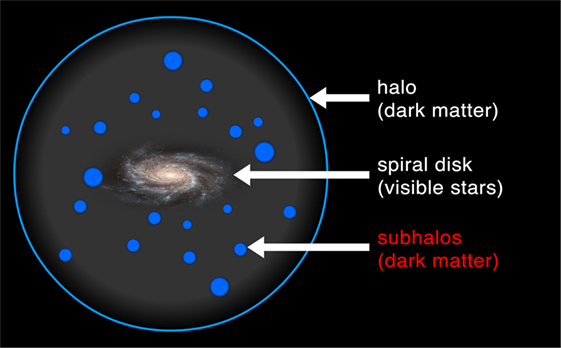
This invisible mass became known as dark matter. According to current estimates, dark matter makes up roughly 80 percent of all matter in the universe and about 27 percent of its total energy content.
Compared to ordinary matter, dark matter is both more abundant and more massive.
Yet it remains completely invisible.
Dark matter does not emit light, does not reflect radiation, and may barely interact with ordinary matter at all. This is why it cannot be detected using conventional instruments.
Its existence is inferred only through gravity — through how it shapes spacetime and holds cosmic structures together.
What Could Dark Matter Be Made Of?
Ordinary matter consists of particles such as protons, neutrons, and electrons, collectively known as baryons. Dark matter, however, is believed to be non-baryonic.
Several candidates have been proposed.
Axions are hypothetical particles with extremely small mass. Individually they would be insignificant, but if they exist in enormous numbers, they could account for much of the universe’s missing mass.
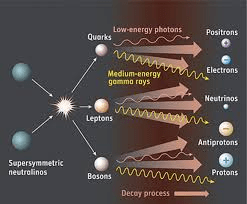
Neutralinos arise from supersymmetry, a theoretical framework suggesting that every known particle has a heavier partner with different spin properties. Neutralinos interact extremely weakly, making them almost impossible to detect directly.
Neutrinos are real, known particles with very small mass. A heavier, hypothetical fourth type has been proposed, but their near-light-speed motion makes them unlikely to remain gravitationally bound inside galaxies.
So far, none of these candidates has been confirmed.
If Dark Matter Is Not Real, What Then?
If dark matter particles are never found, physicists are left with a radical alternative: modifying gravity itself. Instead of adding unseen matter, some theories attempt to adjust Newtonian dynamics to better match observations.
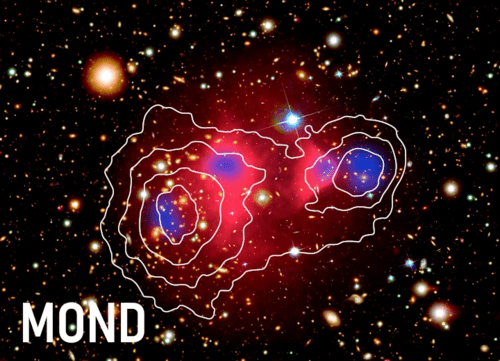
These ideas remain controversial.
They can explain certain galactic behaviors but struggle to account for the full range of cosmological data.
History has shown that particles once considered purely theoretical were later discovered. The search for dark matter continues with multiple detectors operating worldwide.
Even if its nature remains unknown, one thing is clear.
Without dark matter — or something that plays its role — the universe as we observe it would not hold together.