If you pay close attention, you’ll notice something fascinating: almost everything in the universe is rotating.
This rotation can be an object spinning around its own axis, or orbiting around something else.
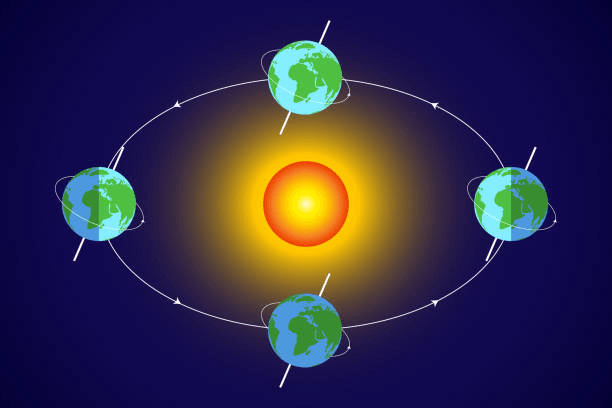
Take Earth as an example. Earth spins on its axis while also orbiting the Sun. And this is not unique—every planet behaves the same way.
From the very beginning, when matter started gathering under gravity, everything moved inward in swirling motions. As material spiraled toward a center, it unintentionally created centrifugal force. When that outward force balanced gravity pulling inward, stable rotation was born. That balance is what allows planets to orbit stars, and stars to orbit galaxies.
So rotation isn’t an accident. It’s a natural outcome of how matter forms in the universe.
The Fundamental Forces That Shape Everything
Our universe is governed by four fundamental forces: gravity, electromagnetism, the strong nuclear force, and the weak nuclear force.
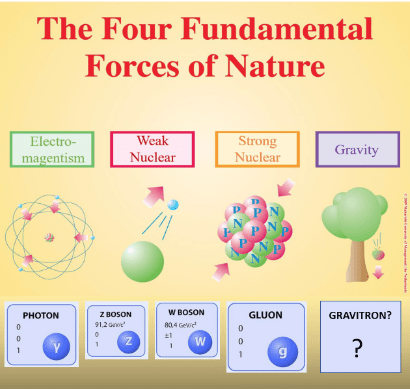
Gravity and electromagnetism are familiar. But the other two are just as important.
The strong force binds quarks together to form protons and neutrons.
The weak force is responsible for radioactive decay and nuclear reactions.
From the tiniest particles to the largest galaxies, everything obeys these same rules. Electrons orbit atomic nuclei. Storms spiral across Earth. Earth orbits the Sun. The Moon orbits Earth. The Sun itself orbits the center of the Milky Way. And our galaxy, along with others in the Local Group, moves around a shared gravitational center.
Seen this way, it would make no sense for the universe itself to be completely still.
The Observable Universe and What We Can Actually See
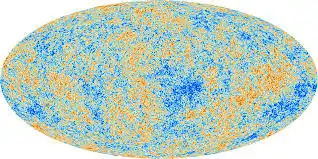
What you often see as a “map of the universe” is actually the cosmic microwave background—the oldest light we can detect. It represents the farthest observable boundary from Earth.
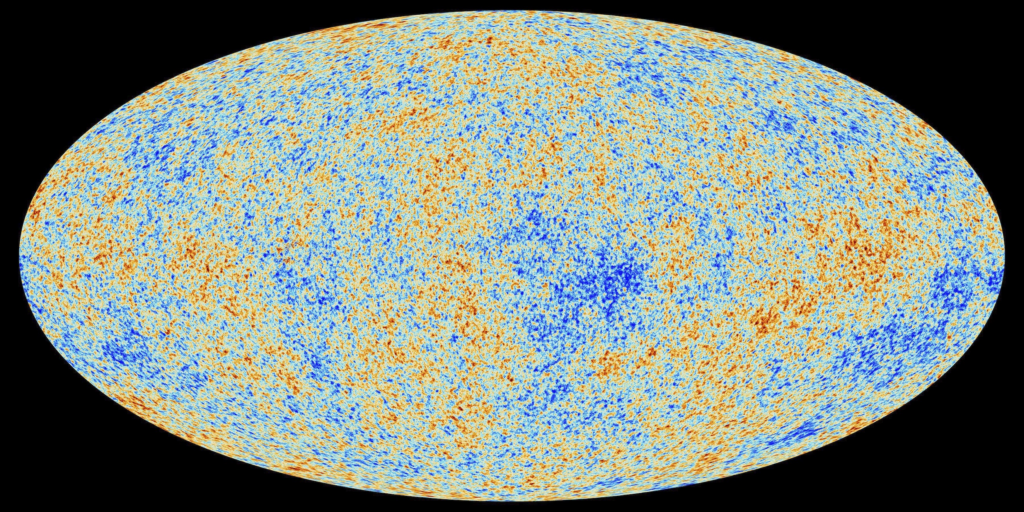
Based on this radiation, scientists estimate the universe to be about 13.8 billion years old. But here’s the catch: this only describes the observable universe, not the entire universe.
We observe the universe outward from Earth in all directions, forming a spherical horizon. If we were standing somewhere else, that observable sphere would look different—yet still similar in shape.
This raises a deep question:
Is the universe much larger than what we can see?
It’s entirely possible that the real size of the universe extends far beyond 13.8 billion light-years—perhaps 20 billion light-years or more in every direction. And to know for sure, we would need to know where the true center of the universe is—something we are certain Earth is not.
For now, the universe’s true size remains one of science’s greatest mysteries.
Could the Universe Itself Be Rotating?
Interestingly, the observable universe appears slightly flattened—much like Earth, which bulges at the equator due to its rotation.
If planets rotate…
If stars rotate…
If galaxies rotate…
Then why should the universe be the exception?
If the universe is rotating, we may never detect it—because we exist inside it. Just as someone standing on Earth doesn’t feel Earth’s rotation directly, we wouldn’t feel the universe spinning around its own axis.
This idea naturally leads to even bigger questions.
Is our universe rotating around something else?
Could it be part of a much larger structure—perhaps a multiverse?
Many scientists openly support multiverse theories. Just like life beyond Earth, the universe may simply be too vast—and our technology too limited—for us to confirm it yet.
Life, Early Origins, and a Crowded Cosmos
Recent discoveries suggest that life may arise very easily under the right conditions. Fossil evidence shows life existed on Earth as early as 3.8–4.3 billion years ago, only a few hundred million years after the Solar System formed—during a time when Earth’s environment was extremely hostile.
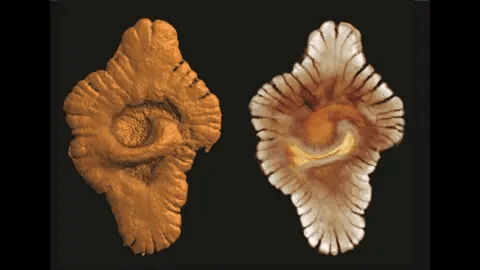
If life could appear that early here, then planets elsewhere in the universe may also host life. Discoveries like the TRAPPIST-1 system have strengthened this belief even further.
The remaining mystery is not whether life exists elsewhere—but whether intelligent life does.
Dark Energy and the Expanding Universe
For a long time, we believed the universe was made entirely of normal matter. Today, we know that only about 5% of the universe is ordinary matter. The rest consists of dark matter and dark energy—mysterious components we can’t directly observe.
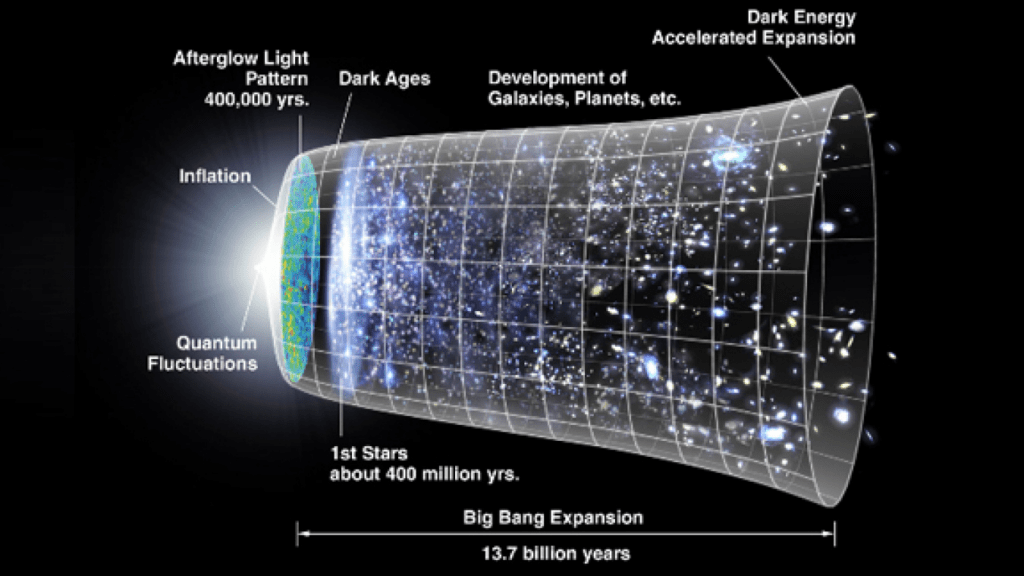
Dark energy is especially strange. It is believed to be responsible for the accelerating expansion of the universe. Not only is the universe expanding—it’s expanding faster and faster.
Some people claim this expansion is now faster than the speed of light. But the truth is more subtle. Space itself can expand faster than light without breaking physics, because objects are not moving through space faster than light—space itself is stretching.
This expansion suggests a bleak but fascinating future: a universe growing colder, emptier, and darker over time.
Redshift, Distance, and the Size of the Universe
The farther away a galaxy is, the faster it appears to be moving away from us—a phenomenon known as redshift.
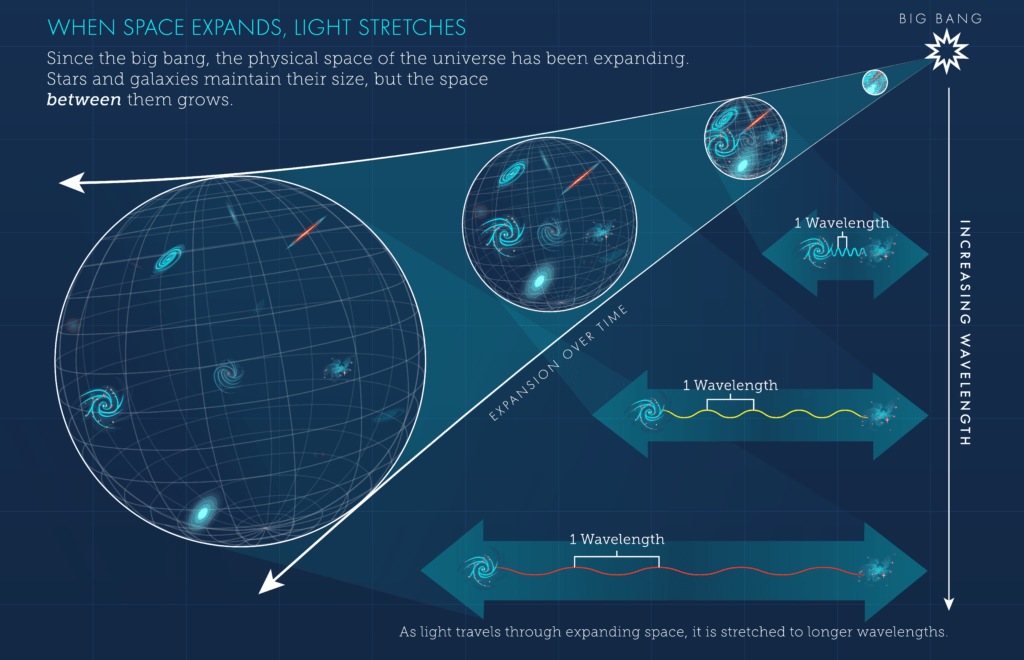
In 2011, astronomers observed one of the most distant known galaxies, with a redshift value of z ≈ 11.9, placing it over 13.4 billion light-years away. Yet due to cosmic expansion, the light from that galaxy took more than 40 billion years to reach us.
This doesn’t mean light slowed down. It means the distance itself grew while the light was traveling.
Based on these observations, the diameter of the observable universe is estimated to be over 90 billion light-years. And even that is not the full universe—just the part we can see.
Every second, expansion rates change. And this makes our understanding incomplete, filled with contradictions and unanswered questions.
What We Know—and What We Don’t
The universe is vast beyond imagination, and it continues to expand. Our current understanding is limited, and some of it may even be wrong.
But that’s the beauty of science.
Future instruments, more powerful telescopes, and new ideas may completely reshape what we think we know. Perhaps we will discover that the universe is infinite. Or that it rotates. Or that intelligent life is everywhere.
Until then, we wait.
And we keep asking questions.
Because every mystery solved only reveals how much more there is to learn.