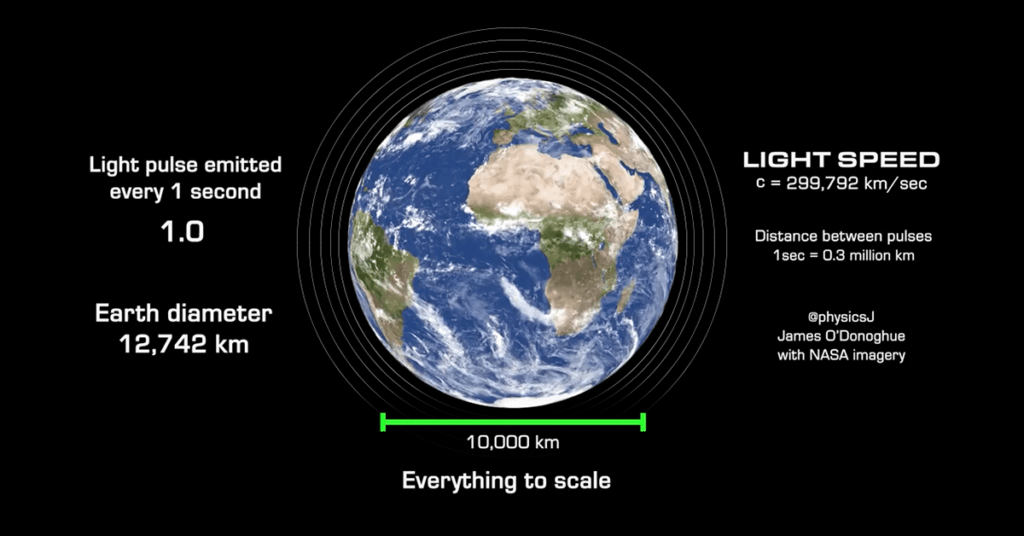
As we all know, light travels incredibly fast. Its speed in a vacuum is nearly 300,000 kilometers per second—more precisely, 299,792 kilometers per second. That’s fast enough for light to circle Earth more than seven times in a single second. One full lap around our planet takes light just about 140 milliseconds.
So far, nothing in the universe has ever been observed moving faster.
This immediately raises a simple but fascinating question:
What exactly is light—and why is it so fast?
What Is Light, Really?
According to physics, light is a form of electromagnetic radiation. The portion we can see with our eyes lies within wavelengths from roughly 380 to 700 nanometers.
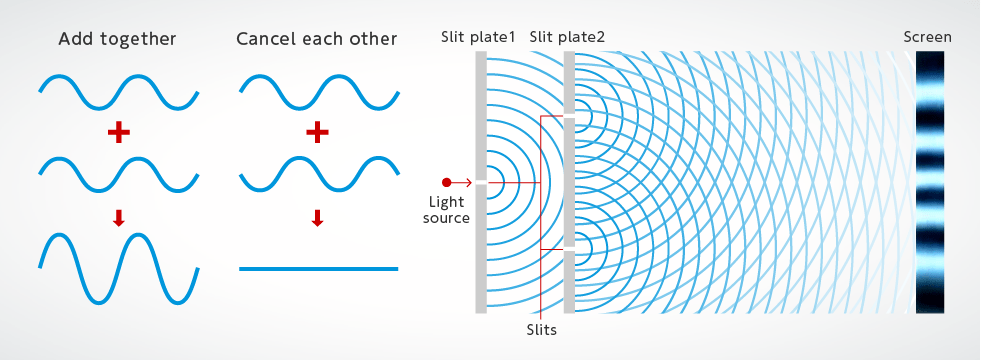
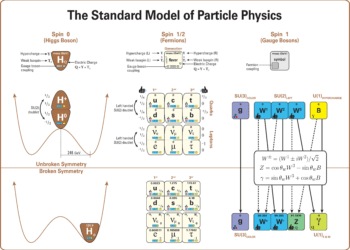
Light behaves in a strange dual way. It travels as waves, yet it is made up of tiny particles called photons. These particles have almost zero mass, which is a key reason they can move at such extreme speeds.
When all wavelengths from violet to red are combined, we perceive white light. Shorter wavelengths appear blue or violet, longer wavelengths appear red. Light concentrated into a very narrow wavelength range is known as monochromatic light.
In simple terms, light is a stream of nearly massless particles moving like waves—at the fastest speed nature allows.
Does Light Always Travel at the Same Speed?
The famous speed of light applies only in a vacuum. When light passes through other materials, its speed changes:
- In Earth’s atmosphere, it slows down slightly
- In water or glass, it can drop to around 200,000 km/s
Because its speed depends on the medium, light clearly interacts with matter. Yet despite this interaction, it still sets the ultimate cosmic speed limit.
Which brings us to the next question.
Can Humans Ever Travel at the Speed of Light?
The short answer is: no.
And the long answer… is also no.
According to the theory of relativity proposed by Albert Einstein, as an object accelerates closer to the speed of light, its mass effectively increases. The faster it goes, the more energy is required. Push it further, and the energy requirement approaches infinity.
To move a spacecraft at just 99% the speed of light, you would need an energy source comparable to an entire star. That alone makes light-speed travel physically impossible with any realistic technology.
So if it can’t be done—why do we even care?
Why Speed Matters in Space
On Earth, the speed of light feels absurdly fast. But on a cosmic scale, it’s surprisingly slow.
The nearest star system beyond our own, Alpha Centauri, is over four light-years away. That means light itself takes more than four years just to get there. Traveling to distant galaxies, millions of light-years away, would be completely unreachable with conventional propulsion.
If we can’t find a way to move close to the speed of light—or bend the rules entirely—interstellar travel remains little more than a dream.
What Would Happen If We Could Travel That Fast?
Let’s imagine, just for a moment, that we somehow board a spacecraft capable of near-light-speed travel.
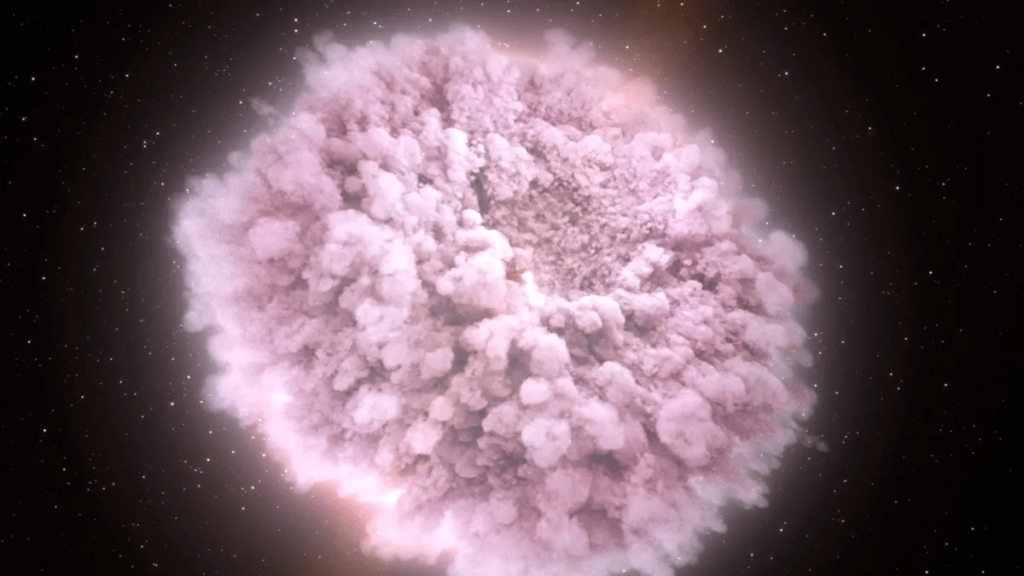
The first danger would be collision. At such velocities, even a particle as small as a grain of dust could release energy comparable to a nuclear explosion upon impact.
Next comes navigation. Steering a ship moving at relativistic speed would require an entirely new form of control. Reacting to obstacles in time would be almost impossible.
Then there’s vision. Our eyes can’t track objects moving even at the speed of sound—let alone near the speed of light. To an observer on board, everything outside might blur into a bright, frozen field of light.
And this is where things get truly strange.
Touching Time Itself
At extreme speeds, time slows down.
This isn’t science fiction—it’s real physics. Time is affected by both speed and gravity. A clock placed at ground level will tick ever so slightly slower than one placed at the top of a skyscraper. Over a thousand years, the difference is only about a second—but it exists.
In stronger gravitational fields, the effect becomes dramatic.
The most extreme example we know is a black hole. Near its event horizon, time slows to a near standstill. To an outside observer, an object falling in appears frozen forever. To the object itself, time continues normally—until physics as we know it breaks down.
We still understand very little about what truly happens there.
Relativity in Everyday Life
All of this might sound abstract, but relativistic time effects already affect us every single day.
Global navigation systems rely on satellites orbiting Earth at speeds of around 7.9 km/s. Because they move faster and experience weaker gravity than objects on the ground, their onboard clocks tick at a different rate.
Without constant corrections based on Einstein’s equations, systems like GPS would drift off by kilometers in a matter of hours.
So yes—time dilation isn’t theoretical. It’s practical.
A Journey to the Stars—and Back
Imagine traveling to Alpha Centauri at near-light speed. The round trip would take more than eight years for people on Earth. But for you on the ship, only a few days might pass.
Three days for you.
Eight years for everyone else.
This strange imbalance is one of the most mind-bending consequences of relativistic travel—and one of the reasons the speed of light feels like a boundary between reality and imagination.
Beyond Light-Speed Dreams
If traveling faster than light is impossible, could there be another way?
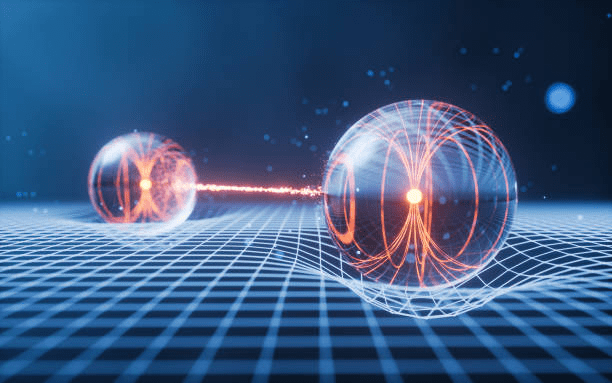
Scientists have explored ideas like wormholes, warped spacetime, and shortcuts through the fabric of the universe itself. These concepts sound wild—and they are—but every great invention once sounded just as impossible.
Human progress has always been driven by ideas that seemed absurd at first.
So if someone ever calls your dreams unrealistic or foolish, remember this:
Every breakthrough in history began as a “crazy” idea.
And perhaps one day, those ideas will take us farther than light itself.