Gravity, Mass and the Strange Geometry of Black Holes
In classical physics, gravitational acceleration depends on two quantities: mass and radius. For ordinary planets, this relationship is intuitive. A larger mass increases gravity, while a larger radius weakens it. Black holes, however, challenge this simple picture. Each black hole has both mass and size, yet its radius is not determined by physical material but by spacetime itself.
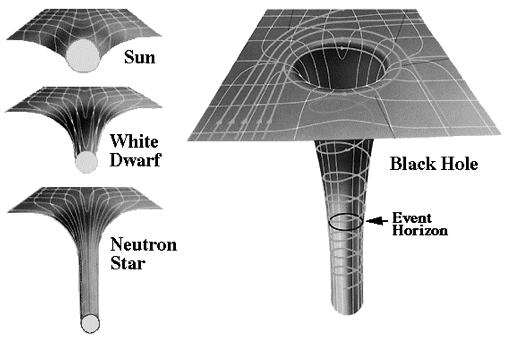
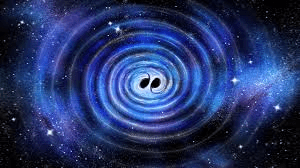
When black holes merge, this strangeness becomes even more apparent. The resulting black hole does not simply combine the properties of its parents in a straightforward way. Instead, the total surface area of the new event horizon is always larger than the sum of the two original horizons. This behavior, first emphasized by Stephen Hawking, appears counterintuitive when compared to ordinary matter, which tends to become denser and more compact as mass increases.
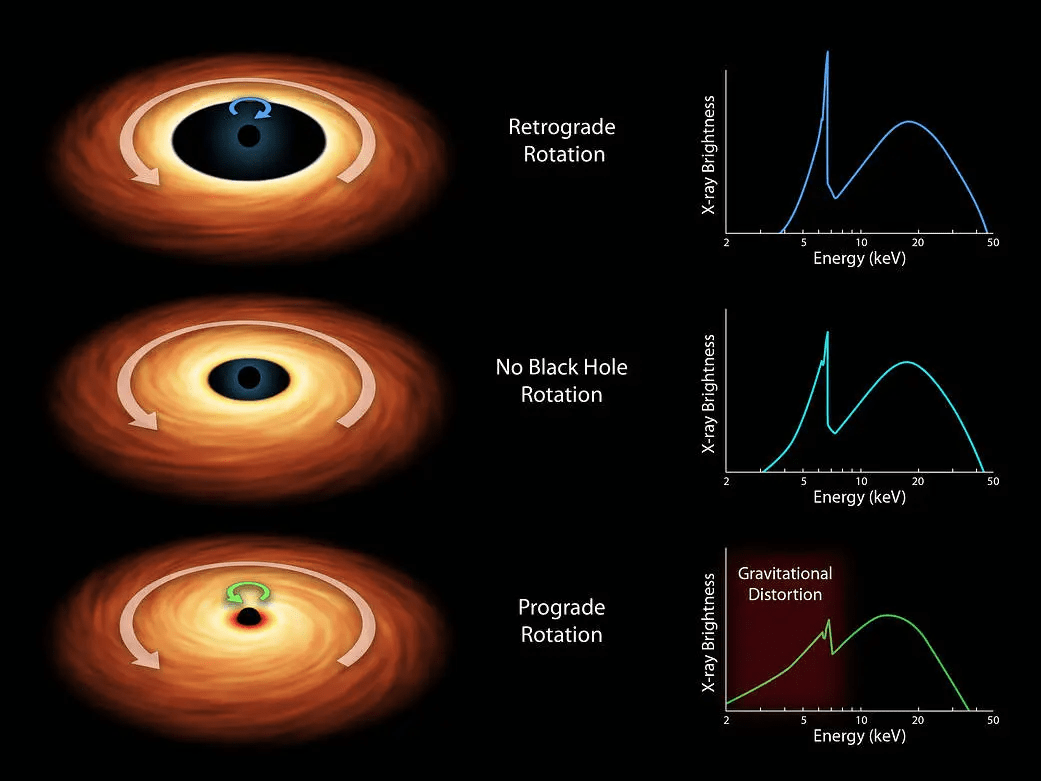
This expansion of surface area is not accidental. It is closely related to the requirement that entropy in the universe must always increase. Even rotation can enlarge a black hole’s horizon without adding mass. When a black hole spins rapidly, spacetime itself is twisted and stretched, increasing the horizon area through effects related to energy extraction and spacetime distortion. In this sense, black holes obey thermodynamic rules that are written directly into the geometry of spacetime.
What Is Inside a Black Hole
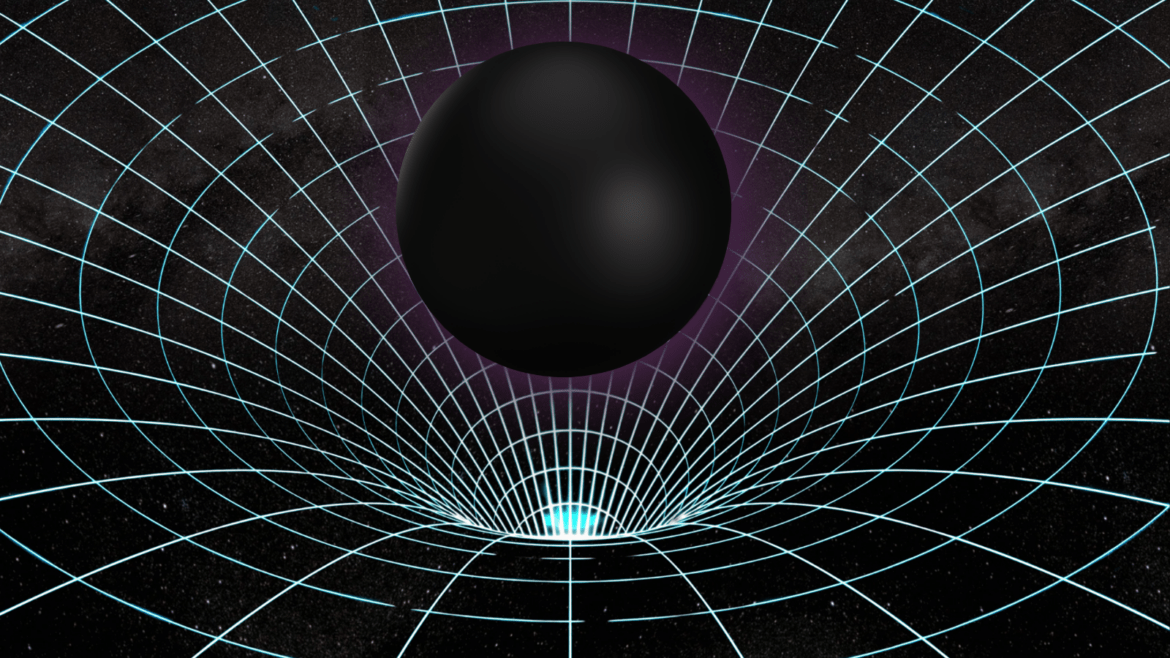
The internal structure of a black hole remains one of the deepest mysteries in physics. No one knows with certainty what lies beyond the event horizon, largely because we do not yet fully understand spacetime itself. Gravity, as described by Einstein, is not a force pulling objects together but a manifestation of curved spacetime shaped by energy.
Black holes do not emit electromagnetic radiation, which means they cannot communicate their internal state to the outside universe through light. As a result, all information about their interiors is hidden from direct observation. It is unclear whether the inside of a black hole consists of compressed particles, exotic states of matter, or something even more fundamental.
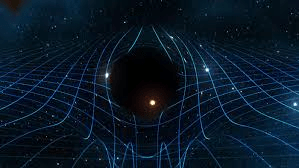
One way to think about a black hole is not as a container of matter, but as a region where spacetime itself is flowing inward. Near the singularity, the curvature becomes so extreme that spacetime may be collapsing faster than light can escape. In this picture, spacetime behaves less like a static grid and more like a waterfall, continuously falling toward the center with no possibility of reversal.
Energy, Matter and the Idea of Pure Gravity
Another way to approach black holes is through the relationship between matter and energy. Photons have no rest mass, yet they are still swallowed by black holes. This raises a natural question: is a black hole truly made of matter, or is it simply a concentration of energy in gravitational form?
In everyday experience, gravity acts without physical contact. We live inside Earth’s gravitational field and the Sun’s gravitational field, yet we cannot touch gravity itself. It is invisible, intangible, but undeniably real. This suggests that gravity may be better understood as energy distributed across spacetime rather than as a substance made of particles.
Modern physics has already shown that matter and energy are interchangeable. Nuclear reactions, radioactive decay, and the early universe all demonstrate this principle. Black holes may represent an extreme case in which matter has been transformed almost entirely into gravitational energy. Stars and planets may exist partly as matter and partly as energy because their gravity is not strong enough to complete this transformation. In black holes, gravity may dominate completely.
Hawking Radiation and the Fate of Information
Quantum mechanics introduces an additional layer of complexity. In quantum theory, systems evolve according to wave equations that preserve information over time. This creates tension with black holes, which appear to destroy information by hiding it forever beyond the event horizon.
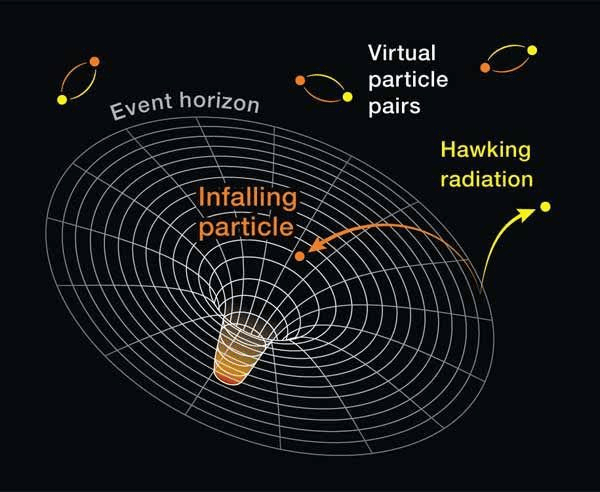
Hawking radiation was proposed as a possible resolution to this conflict. According to the theory, space near the event horizon is filled with quantum fluctuations that constantly produce particle–antiparticle pairs. Occasionally, one particle falls into the black hole while the other escapes. When this happens, the escaping particle appears as radiation, while the black hole loses a tiny amount of mass to conserve energy.
Importantly, nothing actually escapes from inside the event horizon. Hawking radiation does not travel faster than light and does not violate relativity. It originates just outside the horizon, making the question of superluminal motion irrelevant. Although Hawking radiation has not yet been directly observed, it is a logically consistent prediction based on quantum mechanics and relativity.
In this view, black holes may not destroy information after all. Instead, the information carried by matter that falls in may continue to exist in a deeply transformed form, encoded in quantum processes that we do not yet fully understand. Whether a black hole contains matter, energy, or something beyond both remains an open question — one that lies at the boundary of modern physics.