Why Jupiter Formed Early but Never Became a Star
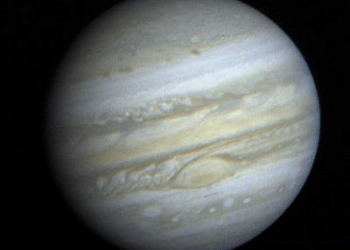
Jupiter’s enormous size suggests that it was one of the earliest planets to form in the Solar System. During the chaotic birth of the Sun and its surrounding planets, vast clouds of gas and dust collapsed under gravity. In that environment, Jupiter quickly accumulated an enormous amount of material and became the largest planet in the system.
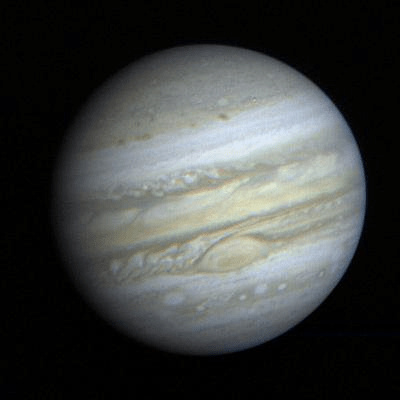
Despite its massive scale, however, Jupiter never became a star. Not even a failed star in the strict astronomical sense.
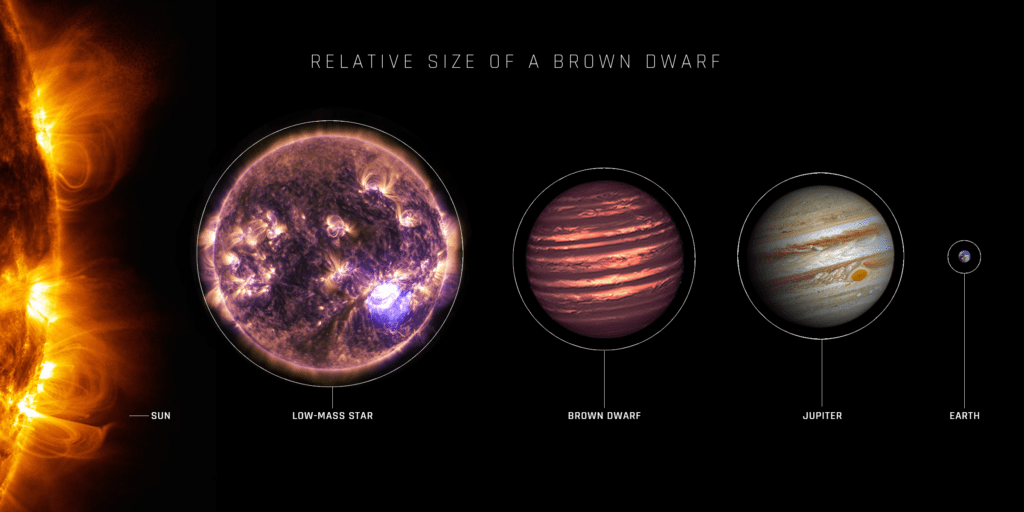
Scientists estimate that an object must have a mass between about 13 and 80 times the mass of Jupiter to be classified as a brown dwarf. These objects occupy the boundary between planets and true stars. If Jupiter somehow merged with at least thirteen planets of similar size, only then could it begin to resemble a brown dwarf.
But in reality, Jupiter is far from reaching that threshold.
The First Step Toward Becoming a Brown Dwarf
At around thirteen times Jupiter’s mass, the core of an object becomes hot enough to ignite a special form of nuclear fusion. This reaction does not involve ordinary hydrogen like in stars, but instead uses deuterium, a rare isotope of hydrogen.
Deuterium consists of one proton and one neutron inside its nucleus. Although it makes up only a tiny fraction of hydrogen in the universe, it has an important property: it can fuse at lower temperatures than normal hydrogen.
When the core temperature of a massive object reaches roughly ten million kelvin, deuterium fusion can begin. In this process, a deuterium nucleus combines with another hydrogen nucleus to form helium-3 while releasing energy.
This limited nuclear burning is what separates brown dwarfs from ordinary gas giant planets.
When Objects Begin to Resemble True Stars
If an object continues gaining mass, the fusion processes inside its core become more complex. At around sixty times the mass of Jupiter, additional reactions involving isotopes such as tritium can occur.
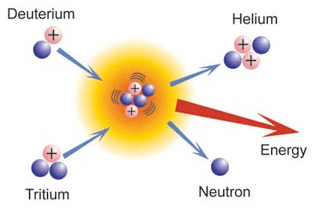
Tritium contains one proton and two neutrons and eventually decays into helium-3 while releasing energy through beta decay. These reactions are still relatively weak compared with the powerful hydrogen fusion that occurs in true stars.
Only when an object reaches about seventy-five to eighty times Jupiter’s mass does it become a genuine star. At that point the core temperature and pressure become high enough for sustained hydrogen fusion, allowing the object to shine steadily on the main sequence like our Sun.
This means brown dwarfs exist in a narrow region between planets and stars, possessing properties of both but belonging fully to neither category.
Even Swallowing All the Planets Would Not Be Enough
Jupiter is already the most massive planet in the Solar System. In fact, its mass is about two and a half times greater than the combined mass of all the other planets together.
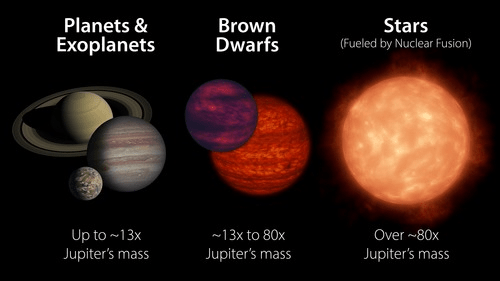
Yet even this dominance is not enough to turn Jupiter into a star.
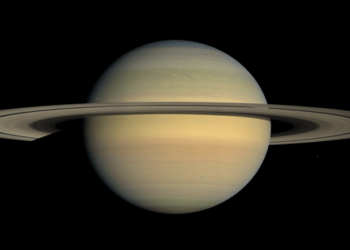
If, in some impossible scenario, Jupiter were able to absorb every other planet in the Solar System — Mercury, Venus, Earth, Mars, Saturn, Uranus, and Neptune — its mass would increase by only about thirty percent.
That is still nowhere near the amount required to become a brown dwarf.
In other words, there is simply no realistic way for Jupiter to collect enough material to ignite nuclear fusion. It will always remain a gas giant planet rather than transforming into a star.
The Future of Jupiter When the Sun Becomes a Red Giant
While Jupiter cannot become a star, its distant future will still be shaped by the evolution of the Sun.
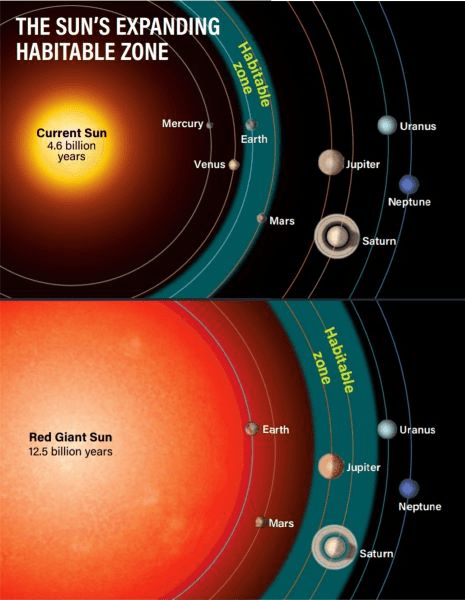
Our Sun is a G-type main sequence star with a total lifetime of roughly ten billion years. About five billion years from now, it will exhaust the hydrogen fuel in its core and begin expanding into a red giant.
During this phase the Sun will grow dramatically in size, potentially extending its outer layers out to the orbit of Earth or even beyond. Many scientists believe that Earth will eventually be engulfed within the Sun’s outer atmosphere.
Mars may also face a similar fate.
For the outer planets, including Jupiter, the situation will be different. As the Sun expands, its surface temperature will decrease but its overall radiation output will increase because the star’s surface area becomes much larger.
What Might Happen to Jupiter in the Distant Future
Astronomers have observed distant planetary systems where gas giants orbit stars that are already entering the red giant phase. In some of these systems the planets appear to lose atmosphere rapidly due to intense stellar winds.
In other cases the opposite seems to happen. Some planets absorb large amounts of radiation and stellar material, causing their atmospheres to expand and swell dramatically.
Eventually, when a Sun-like star sheds its outer layers and becomes a white dwarf, the surrounding planets may experience even more extreme changes.
Gas giants such as Jupiter and Saturn might lose large portions of their atmospheres, or possibly even most of their gaseous envelopes. If that happens, what remains could be the mysterious core hidden deep inside the planet.
The Hidden Mystery Inside Jupiter
The true nature of Jupiter’s core remains one of the biggest mysteries in planetary science.
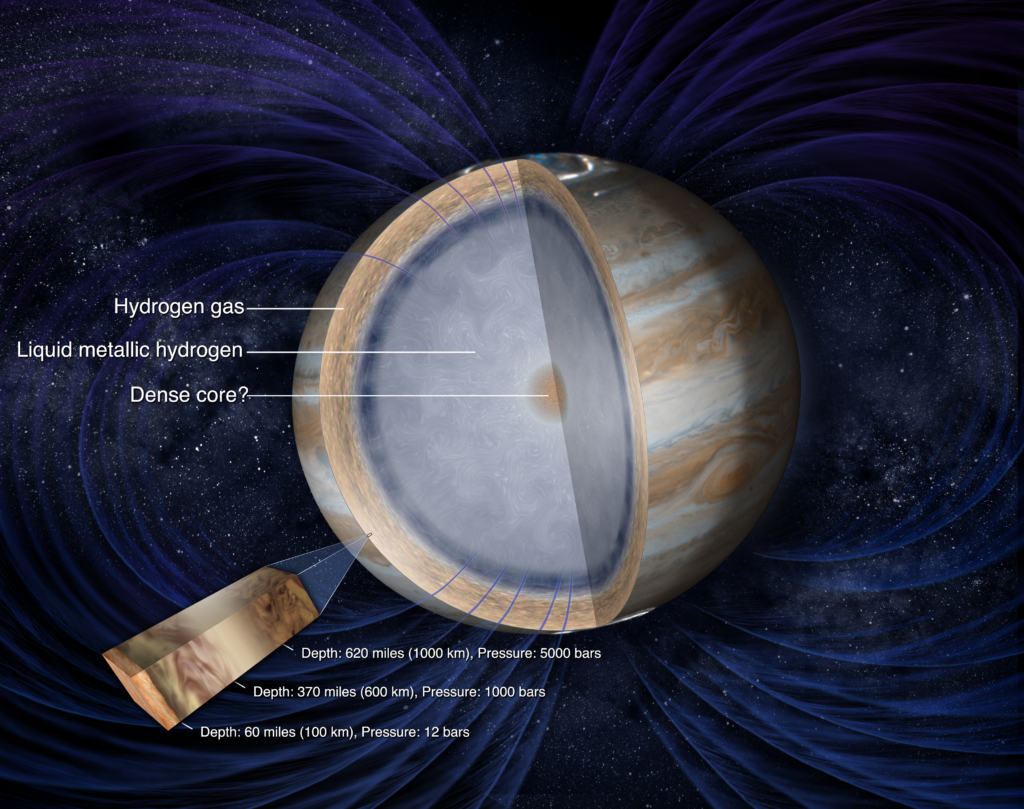
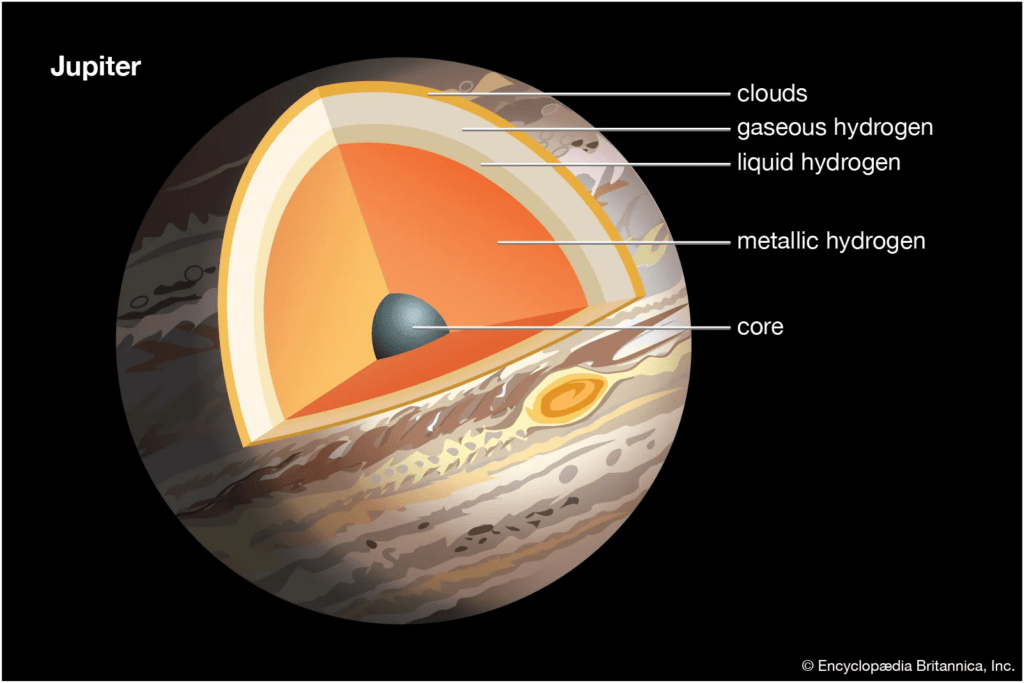
Because Jupiter is wrapped in a thick atmosphere and immense pressures, directly observing its interior is extremely difficult. Scientists must rely on indirect measurements, such as gravitational data and magnetic field observations, to infer its internal structure.
Current models suggest that beneath Jupiter’s upper layers of hydrogen gas lies a vast region of liquid hydrogen. Deeper still, the pressure becomes so extreme that hydrogen transforms into liquid metallic hydrogen, a strange state of matter where electrons move freely like they do in metals.
This metallic hydrogen layer is believed to act like a giant electrical generator. As Jupiter rotates, the moving conductive fluid generates the powerful magnetic field that surrounds the planet.
At the very center may lie a core made of rock and heavy elements. However, data from the Juno spacecraft suggests that this core may be larger and more diffuse than scientists once expected.
For now, the heart of Jupiter remains hidden beneath thousands of kilometers of gas and exotic matter, leaving one of the Solar System’s greatest giants still holding many of its secrets.