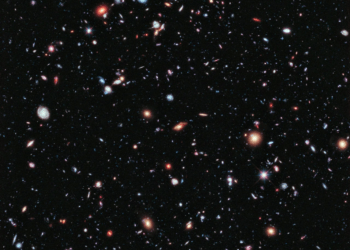
The Beginning of the Question
For most of human history, people looked at the night sky and wondered whether the universe had always existed or whether it had a beginning. In modern science, answering this question works much like solving a complex investigation: researchers must collect evidence, test ideas, and gradually narrow down the most consistent explanation.
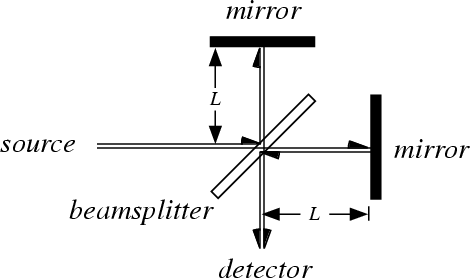
One of the earliest clues that changed our understanding of the universe came from studying light itself. A photon carries information across vast cosmic distances, allowing scientists to analyze the structure and history of the universe through the light arriving from distant stars and galaxies.
But before the modern view of space emerged, physicists believed that light needed a medium in which to travel.
The Fall of the Ether
In the late 19th century, scientists widely accepted the idea of the luminiferous ether—a hypothetical invisible substance filling all of space. According to this idea, electromagnetic waves such as light would propagate through this medium.
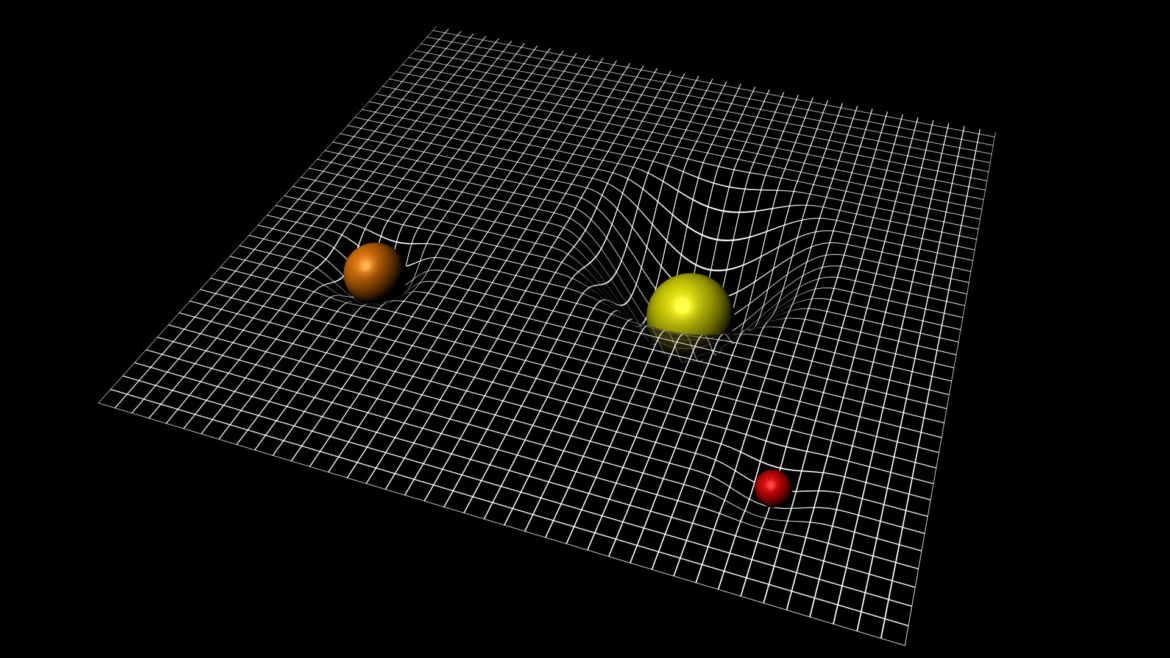
This view began to collapse after the famous Michelson–Morley experiment, performed by Albert A. Michelson and Edward W. Morley. Their experiment attempted to detect Earth’s motion through the ether by measuring variations in the speed of light.
Instead, they found something unexpected: the speed of light appeared constant in every direction.
This result suggested that ether did not exist, forcing physicists to rethink the nature of space, motion, and light itself.
Einstein and the New Nature of Space and Time
A few years later, Albert Einstein revolutionized physics by proposing the Theory of Special Relativity. In this theory, the speed of light is constant for all observers, regardless of their motion.
Einstein later extended these ideas into the General Theory of Relativity, which described gravity not as a force but as the curvature of spacetime caused by mass and energy.
These theories dramatically changed our understanding of the universe. Space and time were no longer fixed backgrounds but dynamic structures capable of bending, stretching, and evolving.
The First Idea of an Expanding Universe
Einstein initially believed the universe was static and unchanging. However, mathematicians studying his equations began to notice something surprising.
In the 1920s, the Russian physicist Alexander Friedmann found solutions to Einstein’s equations that described a universe that could expand or contract. Shortly afterward, the Belgian physicist and priest Georges Lemaître proposed that the universe might have originated from an extremely dense and compact initial state.
Lemaître called this idea the “primeval atom,” a concept that would later evolve into the modern Big Bang theory.
Observational Evidence from the Expanding Cosmos
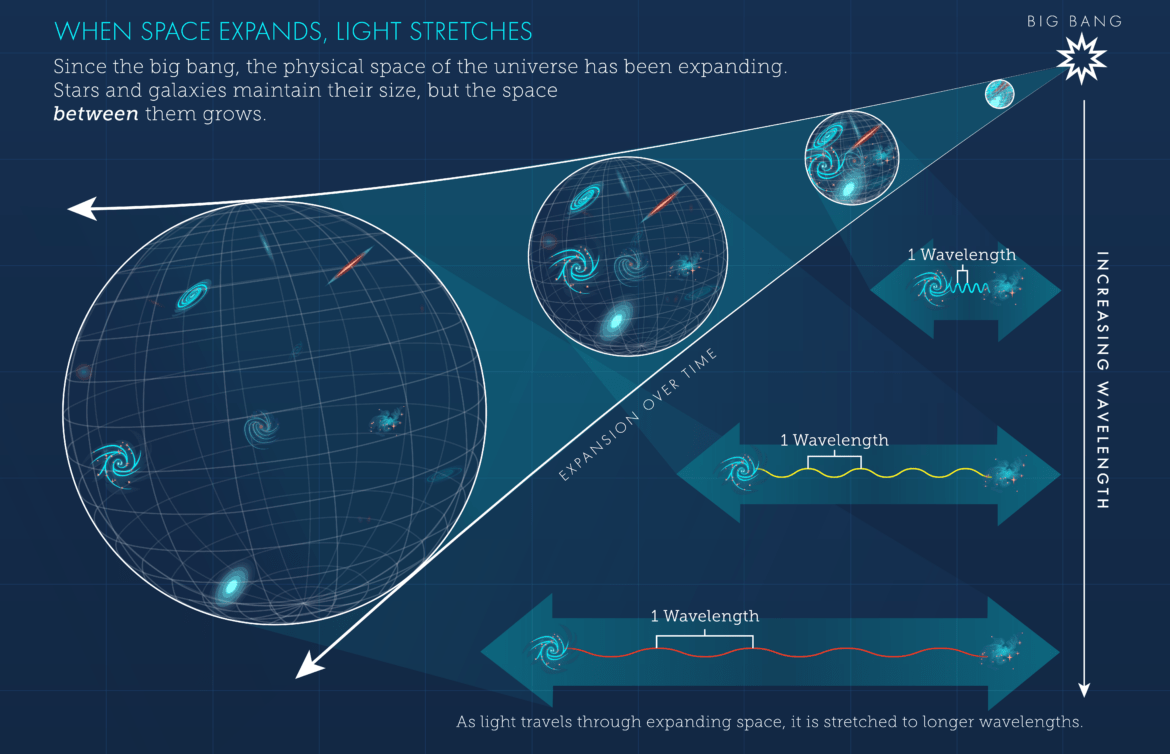
The theoretical ideas gained strong support when the astronomer Edwin Hubble studied distant galaxies and discovered that nearly all of them were moving away from us.
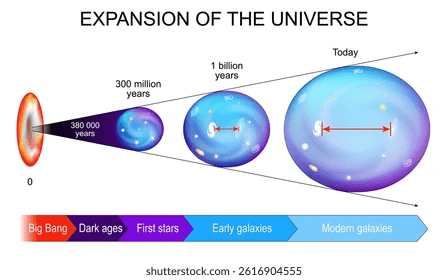
Even more remarkably, the farther a galaxy is, the faster it appears to recede. This relationship—known today as Hubble’s Law—demonstrated that the universe itself is expanding.
If the universe is expanding today, then logically it must have been smaller in the past. Following that reasoning far enough backward leads to a moment when the universe was extremely dense and hot.
This realization provided one of the strongest arguments for a cosmic beginning.
The Discovery That Confirmed the Theory
Although the expanding universe strongly supported the idea of a cosmic origin, scientists needed more direct evidence.
In 1964, two researchers at Bell Labs, Arno Penzias and Robert Wilson, accidentally discovered faint microwave radiation filling the entire sky.
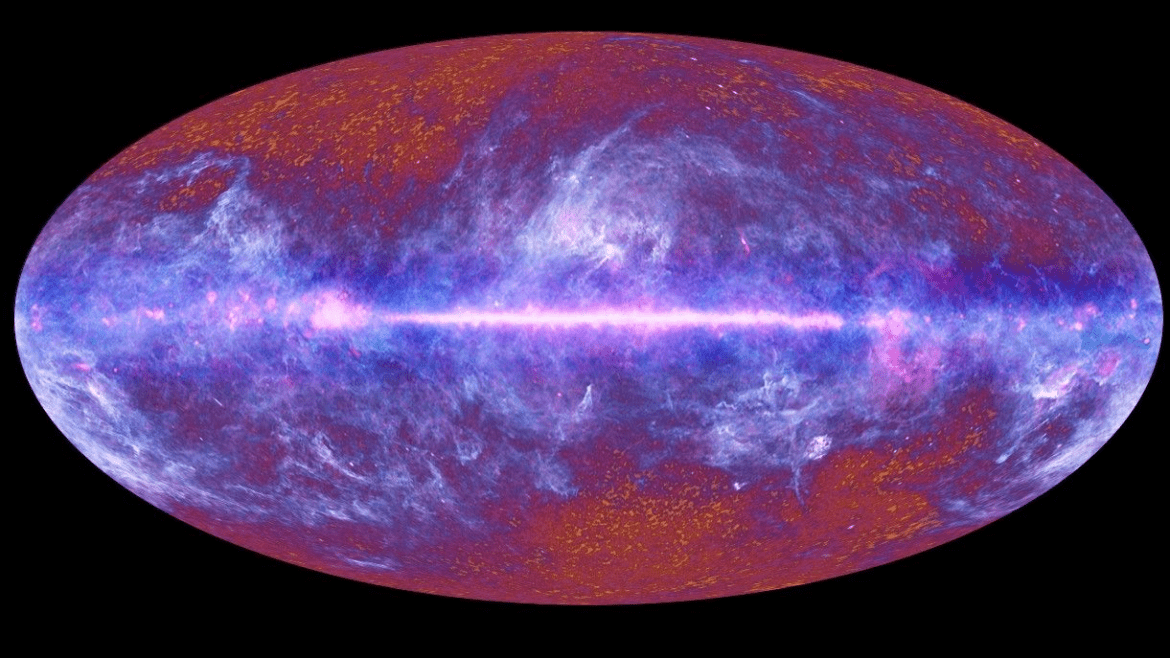
This radiation turned out to be the Cosmic Microwave Background—a relic from the early universe when it was hot, dense, and filled with plasma.
This discovery provided powerful confirmation that the universe once existed in a much hotter and denser state, exactly as predicted by the Big Bang model.
Inflation and the Uniform Universe
Modern observations reveal another remarkable feature: the universe appears almost perfectly uniform in temperature across enormous distances.
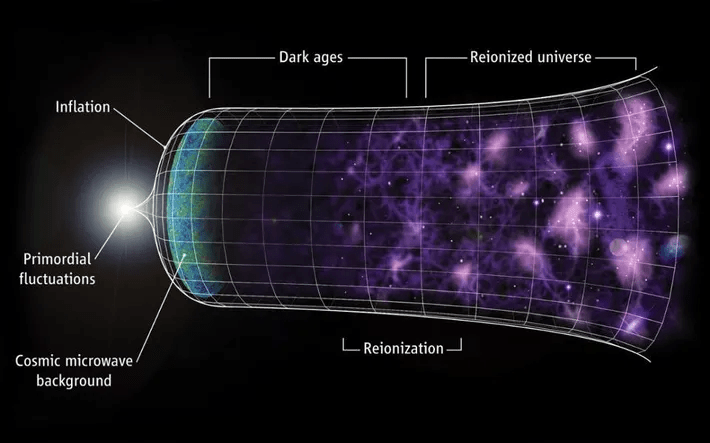
To explain this, the physicist Alan Guth proposed the idea of Cosmic Inflation. According to this theory, the universe underwent an extremely rapid expansion in the first tiny fraction of a second after its birth.
During this brief period—between roughly 10−36 and 10−32 seconds—the universe expanded faster than the speed of light in terms of spacetime stretching. This process smoothed out irregularities and created the remarkable uniformity we observe today.
Although inflation remains under active investigation, it provides a compelling explanation for several puzzles in cosmology.
Why the Universe May Have Begun Extremely Small
One final question remains: why do many cosmological models describe the early universe as an extremely small and dense state?
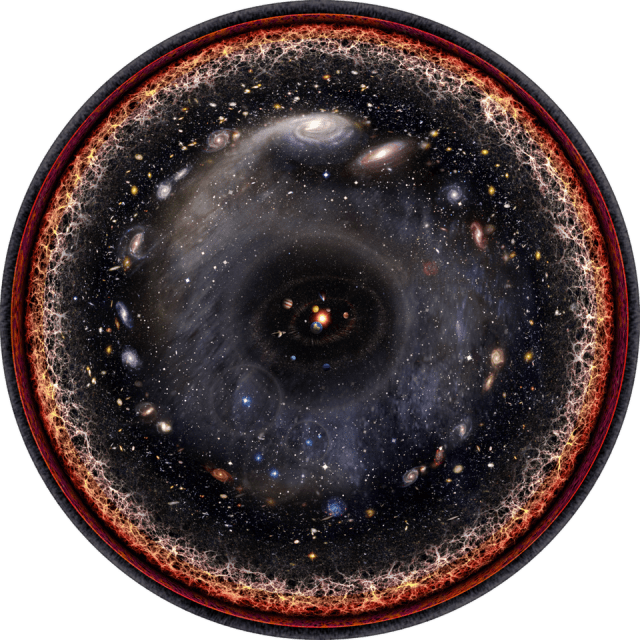
The reason comes from the remarkable uniformity of matter and energy throughout the cosmos. If the universe had begun as a large object exploding outward, the distribution of matter would likely be uneven, much like debris from a stellar explosion.
Instead, observations show that matter and radiation were initially distributed almost perfectly uniformly.
The simplest explanation is that the early universe began in an incredibly compact state—perhaps effectively a single point of extremely high density—from which space itself began expanding.
For now, this idea remains the foundation of modern cosmology. Until new evidence suggests otherwise, the Big Bang model remains the most consistent explanation we have for how our universe began.