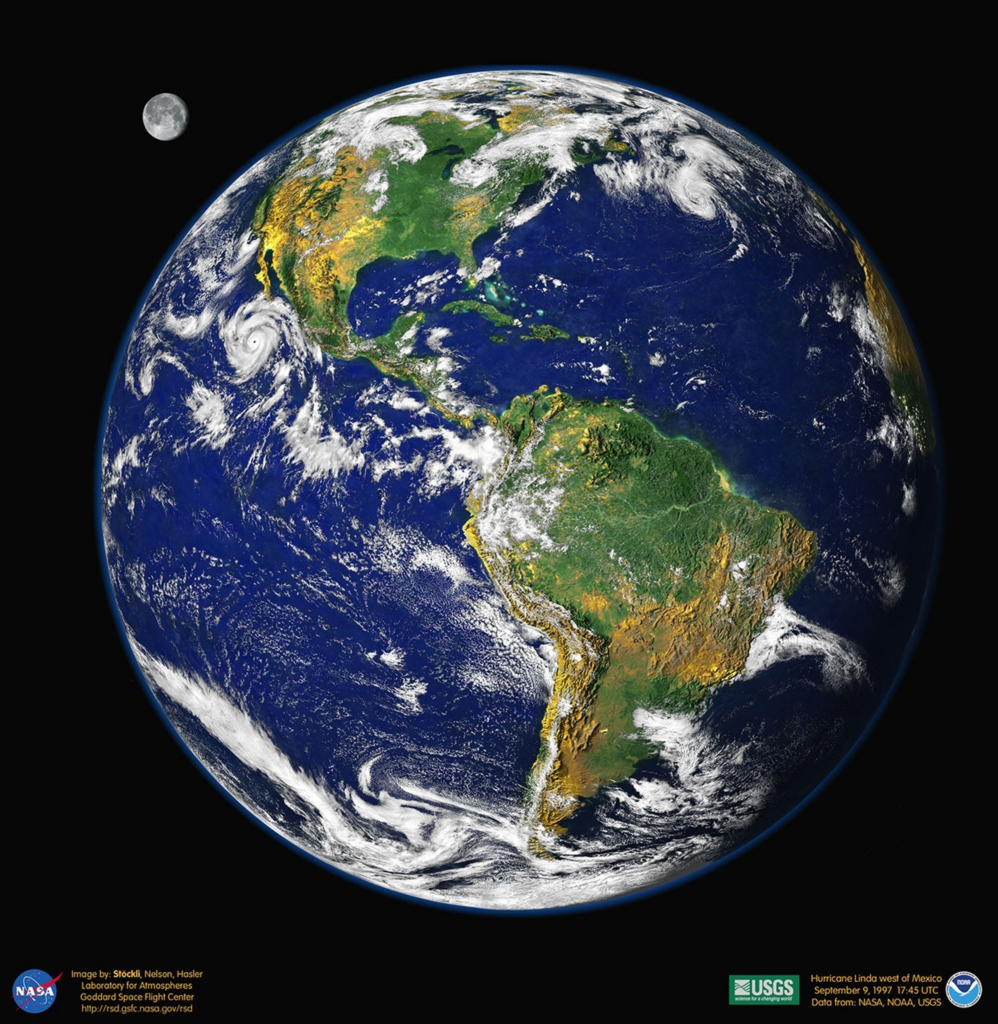
Earth—our blue planet—is the third rocky world from the Sun.
It is a place that feels familiar, yet remains deeply mysterious. As far as we know today, Earth is still the only world in the universe that hosts life.
For centuries, humans have pointed their telescopes toward the sky, quietly observing the cosmos. With every generation, our understanding of the universe grows a little more complete. And yet, no matter how much we learn, there are still countless mysteries waiting to be answered.
So today, let’s take a step back and explore our larger home: the Solar System.
What Is the Solar System?
The Solar System—also known as the Thái Dương Hệ—is a planetary system centered around a single star: the Sun. Bound together by gravity, planets, moons, asteroids, and countless smaller objects all orbit this central source of light and energy.
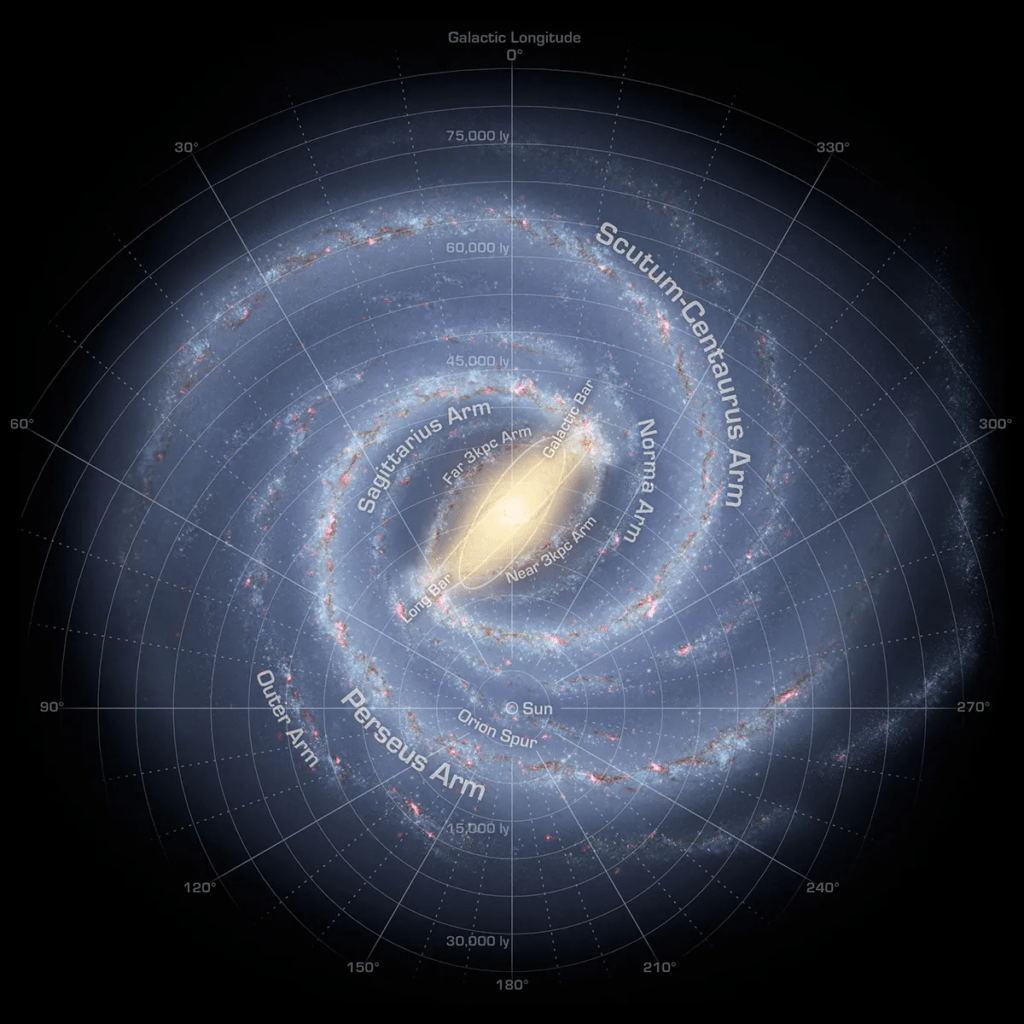
Our Solar System is located on the outer edge of a spiral galaxy called the Milky Way, which measures roughly 100,000 to 150,000 light-years across. We sit about 30,000 light-years away from the galactic center, traveling through space at a speed of around 220 km per second.
One complete orbit of the Solar System around the Milky Way takes approximately 250 million years. Since its formation, our system has completed about 18 galactic orbits—often referred to as 18 galactic years.
From the outside, the motion of the Sun pulling its planets through the galaxy may look chaotic. But in reality, this dance has remained remarkably stable for billions of years. We are moving through space in what feels like disorder—yet it is a very precise kind of order.
The Edge of the Solar System
If we could observe the Solar System from afar, it would appear as a vast spherical region stretching up to one light-year in radius. This distant boundary is defined by the Oort Cloud, a massive shell of icy objects, dust, and debris left over from the early formation of the Solar System.
These objects never became planets because the Sun’s gravity was not strong enough at such distances. Many scientists believe that long-period comets originate from this region, making the Oort Cloud the true outer frontier of our Solar System.
The Planets and Their Orbits
Starting from the farthest known planet and moving inward:
- Neptune – ~30 AU (4.5 billion km)
- Uranus – ~19.6 AU
- Saturn – ~9.5 AU
- Jupiter – ~5.2 AU
- Asteroid Belt – between 2.3 and 3.3 AU
- Mars – ~1.5 AU
- Earth – 1 AU (150 million km)
- Venus – ~0.7 AU
- Mercury – ~0.4 AU
(1 AU = the average distance between Earth and the Sun)
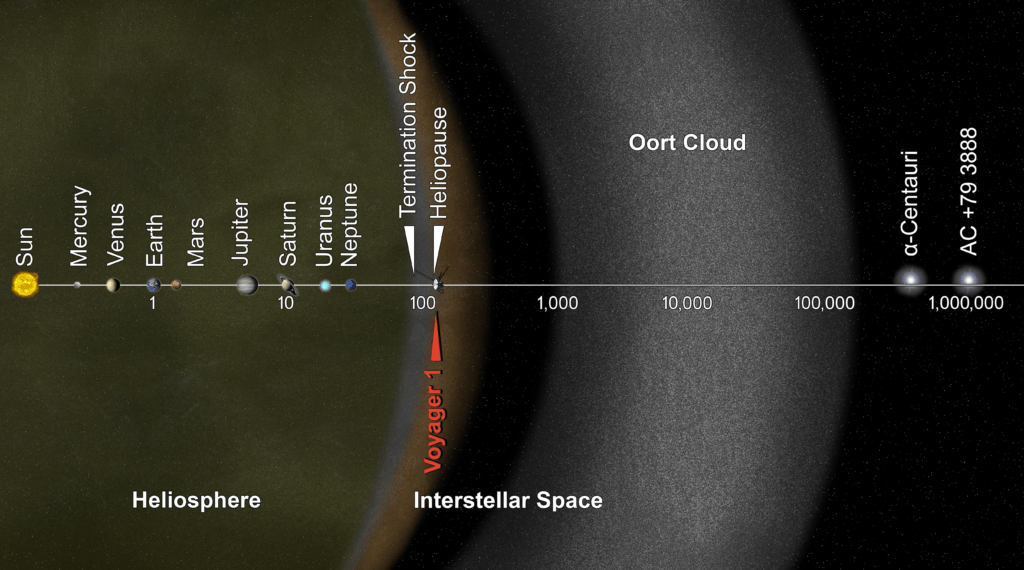
Planetary orbits are elliptical, not perfect circles, and planets subtly influence one another through gravity. For reference, astronomers use Earth’s orbital plane—called the ecliptic plane—which is tilted about 60 degrees relative to the Milky Way’s plane.
Light from the Sun takes about 4 hours to reach Neptune, and nearly one full year to travel all the way to the Solar System’s outer boundary.
Exploring Beyond with Spacecraft
Beyond Neptune lies the Kuiper Belt, a region extending from 30 to 50 AU, filled with icy bodies, dwarf planets, and remnants of planetary formation.
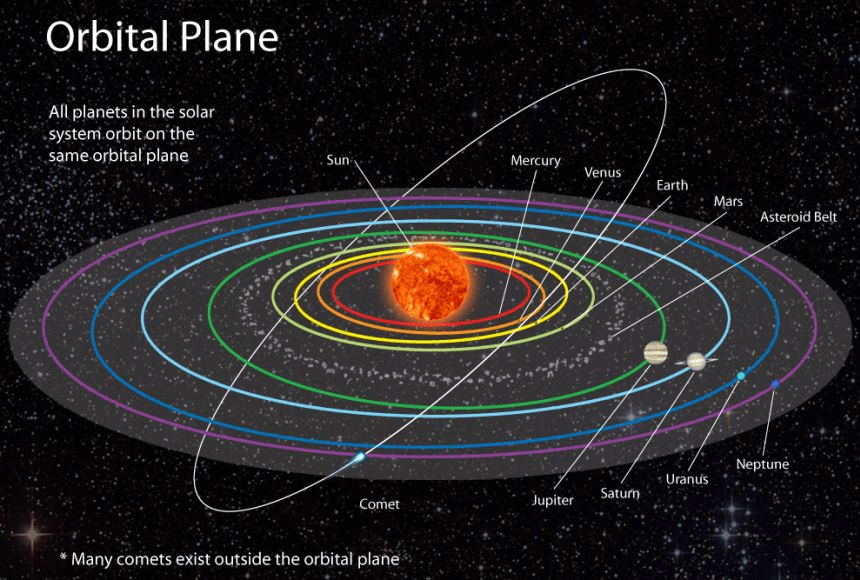
Humanity’s first true explorers of deep space were Voyager 1 and Voyager 2, launched in 1977. Even today, they continue their journey into interstellar space, now more than 18 billion kilometers away from Earth.
Later missions such as Cassini expanded our understanding of the outer gas giants and their moons—some of which may contain environments suitable for life.
But before we explore further outward, we must begin at the center.
Mercury and Venus – The Inner Extremes
Mercury, the smallest and closest planet to the Sun, is a world of extremes. It has almost no atmosphere, no moons, and drastic temperature swings—from 430°C during the day to –173°C at night. It is geologically inactive and covered in impact craters, making it a truly dead world.
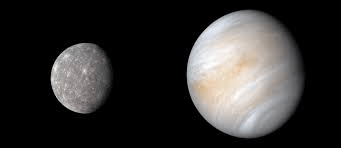
Next comes Venus, often called Earth’s “twin” due to its similar size and mass. But Venus is anything but Earth-like. Its dense atmosphere, made mostly of carbon dioxide and sulfuric acid clouds, traps heat so effectively that surface temperatures reach 470°C, making it the hottest planet in the Solar System.
Venus rotates backward, has crushing air pressure, and experiences lightning far more powerful than anything on Earth. Once imagined as a tropical paradise, Venus proved to be one of the most hostile worlds we’ve ever explored.
Earth – Our Only Known Haven
And then there is Earth—the only planet known to support life.
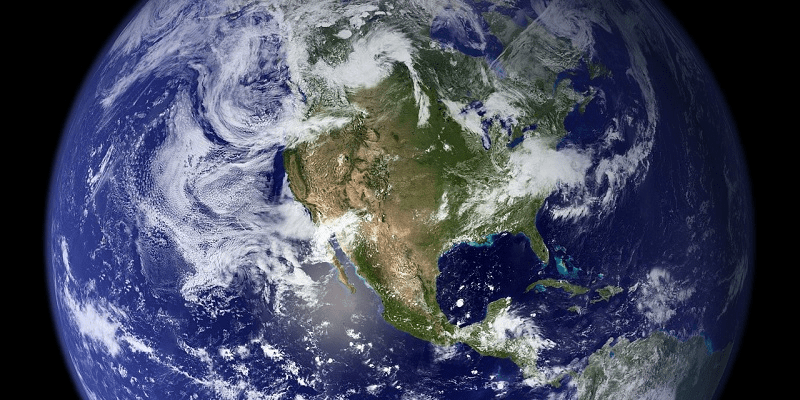
Earth’s layered structure, liquid water, protective atmosphere, and stable orbit make it uniquely suited for life as we know it. About 70% of its surface is covered by water, and its tilted axis gives rise to the seasons that shape our climate.
However, Earth is changing. Rising global temperatures, pollution, and rapid population growth are putting increasing strain on the planet. Some scientists estimate that life on Earth may only remain sustainable for another 1.5 billion years, even without catastrophic cosmic events.
Because of this, the idea of finding—or creating—a new home for humanity is no longer science fiction. In the coming centuries, living on multiple planets may become not just possible, but necessary.
And for the first time in history, we have real reasons to hope.