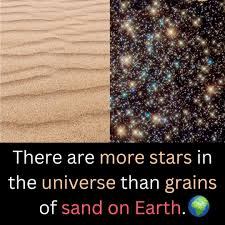
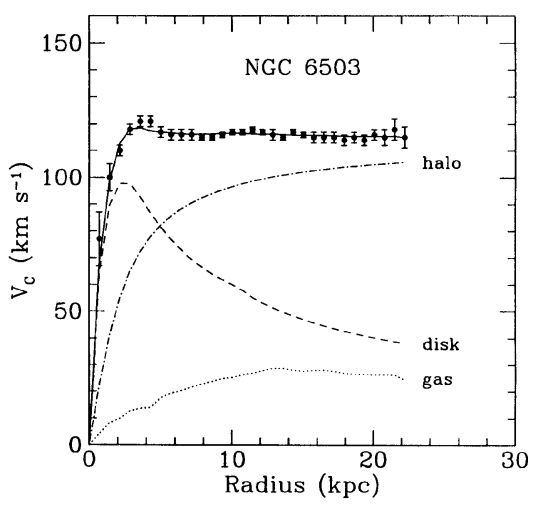
When we look up at the night sky, it’s easy to forget just how overwhelming the numbers really are.
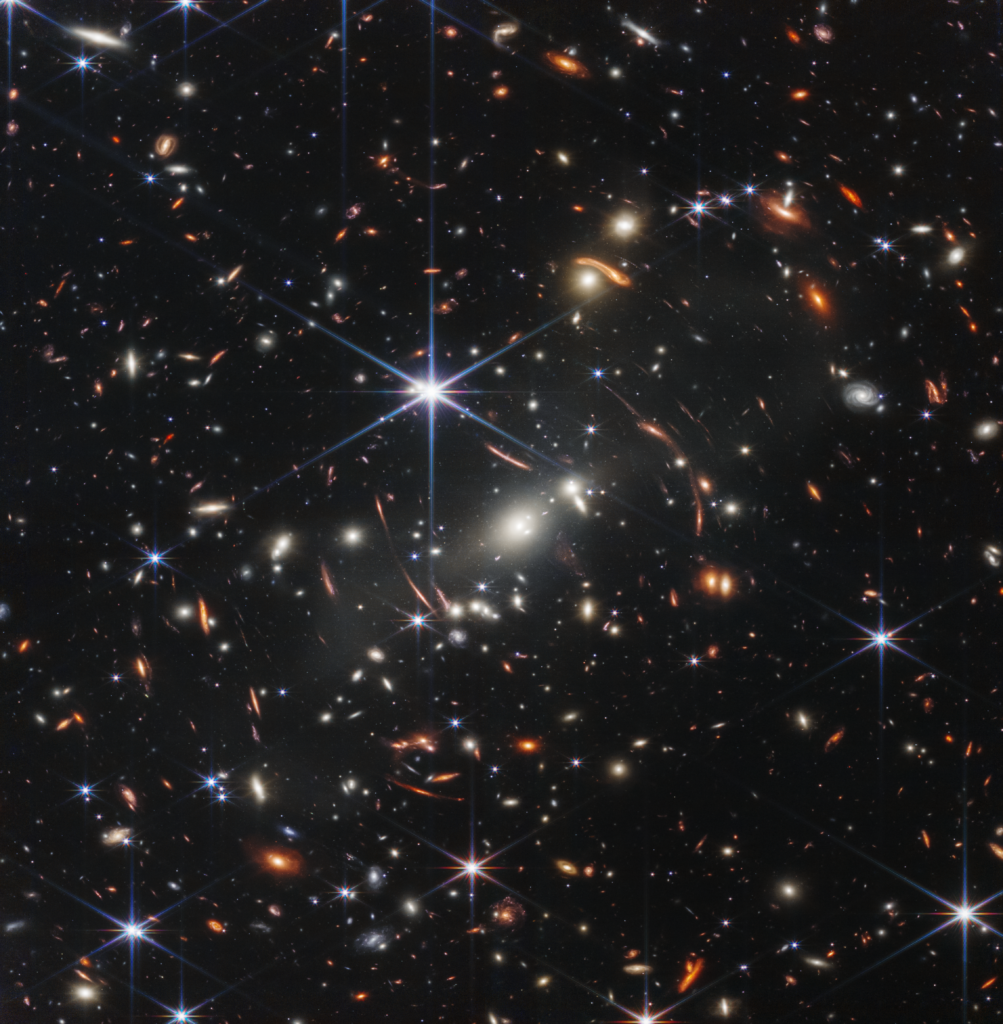
Inside Milky Way alone, scientists estimate there are around 200 billion stars shining. And beyond our galaxy? There may be 100 billion—or even trillions—of galaxies spread across the universe.
That means the total number of stars is so large that counting them becomes meaningless.
Some stars are gigantic—millions of times larger than the Sun.
Others are smaller than Earth itself.
Some burn brightly for only a few million years, while others are nearly as old as the universe.
Almost all of them are unimaginably far away. Even the closest star system beyond our own is several light-years distant. With today’s fastest spacecraft, reaching it would still take thousands of years.
So today, instead of traveling there, let’s explore them with our minds.
The Sun – Our Nearest Star
The Sun is the closest star to Earth, sitting about 149.6 million kilometers away. Light from the Sun takes 8 minutes and 19 seconds to reach us.
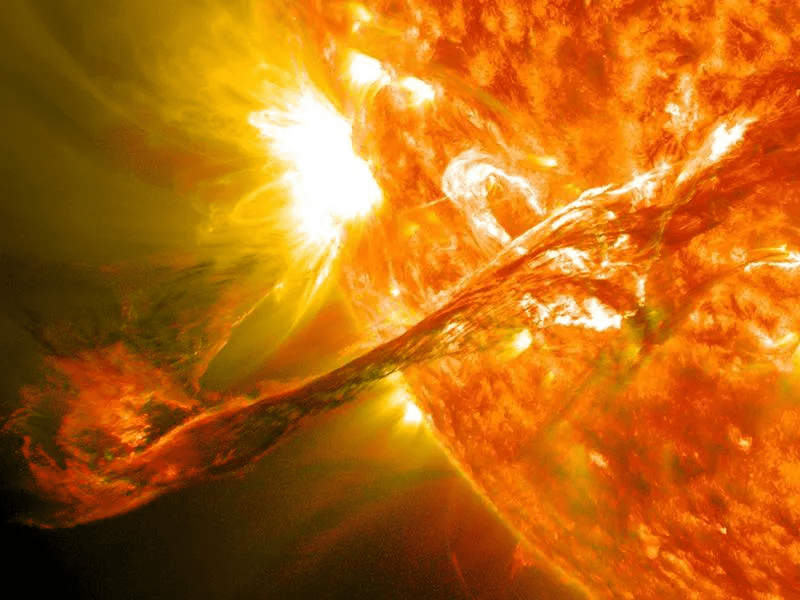
Like all stars, the Sun is a massive sphere of plasma—essentially a gigantic nuclear reactor. Its composition is mostly hydrogen (73%), followed by helium (24%), with traces of heavier elements like oxygen, carbon, iron, silicon, and neon.
Although its surface looks calm from afar, the Sun is far from stable. Deep inside its core, matter becomes incredibly dense and hot, driving the nuclear reactions that power everything in our solar system.
Astronomers classify the Sun as a yellow dwarf star—“dwarf” not because it’s small, but because there are far larger stars out there.
Some quick numbers to put things in perspective:
- Diameter: about 1.4 million km (109 times Earth’s)
- Surface temperature: ~5,700°C
- Core temperature: ~13 million°C
- Mass: 99% of the entire Solar System
In reality, what we call the “Solar System” is basically the Sun… and a few tiny dots orbiting around it.
Our Nearest Stellar Neighbors
The closest star system to us is Alpha Centauri, located about 4.35 light-years away. It’s actually a triple-star system, consisting of Alpha Centauri A, Alpha Centauri B, and Proxima Centauri.
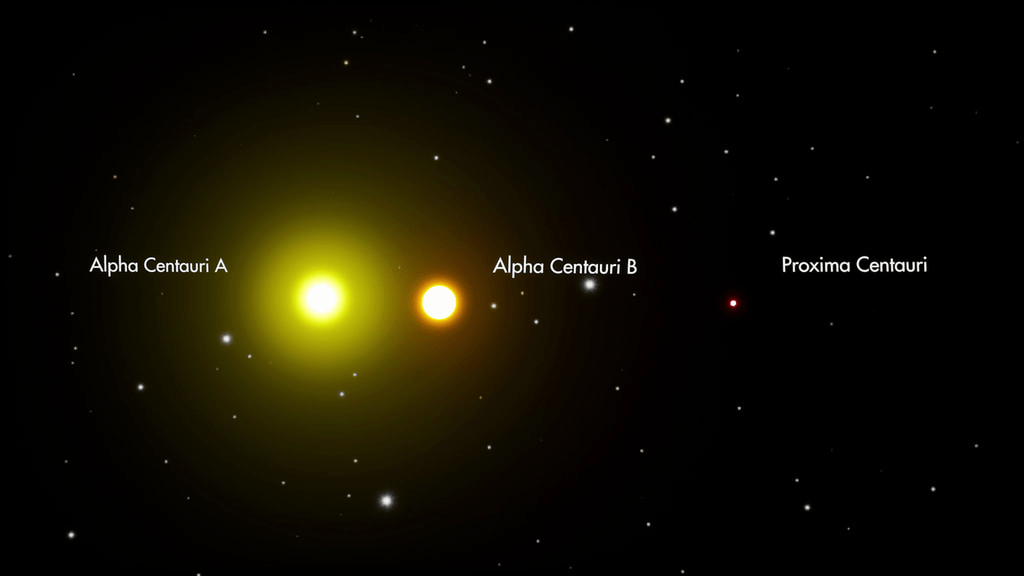
The two main stars are similar to the Sun, while Proxima Centauri is a small red dwarf—much cooler and dimmer.
In 2012, astronomers discovered an Earth-mass planet orbiting one of these stars. Unfortunately, it orbits extremely close to its parent star, completing a year in just 3.2 days—far too hot for life as we know it.
Traveling there is still far beyond our current technology. But Stephen Hawking once suggested that within 200 years, humanity might reach Alpha Centauri. Four light-years, he argued, may not be so far after all.
The Brightest Star in Our Night Sky
If we ignore the Moon and Venus, the brightest star visible from Earth is Sirius, also known as the “Dog Star.”
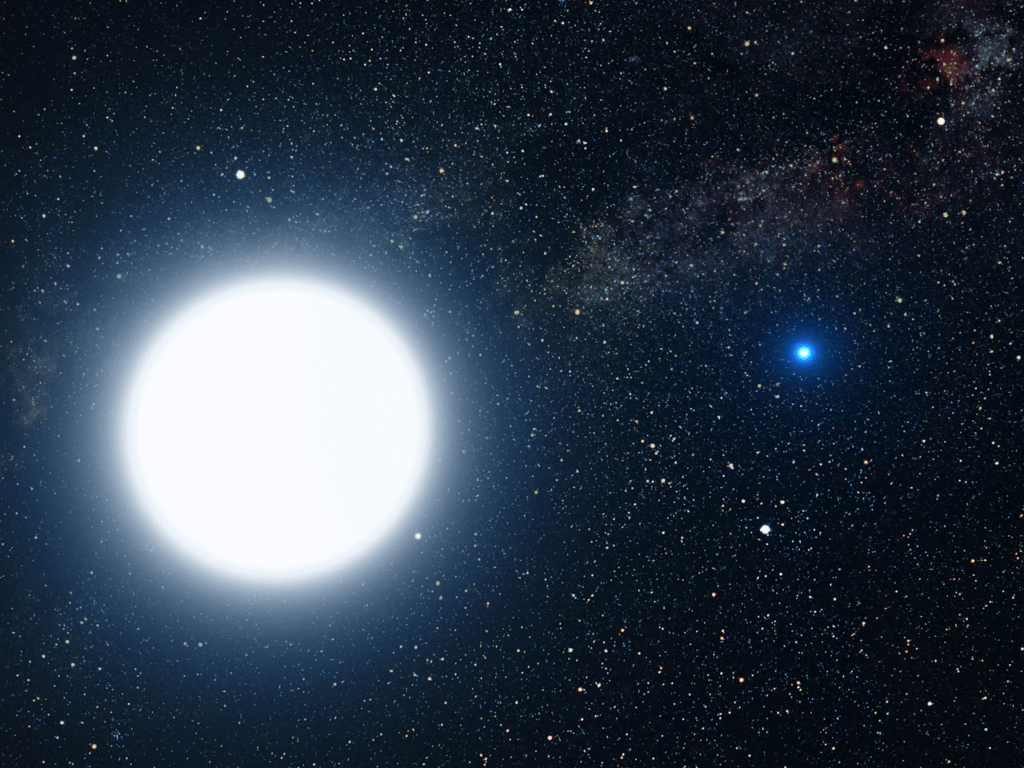
Sirius lies about 8.6 light-years away and is actually a binary star system:
- Sirius A – nearly twice the Sun’s size and 25 times brighter
- Sirius B – a white dwarf, roughly Earth-sized but with a mass comparable to the Sun
White dwarfs are some of the strangest objects in the universe. A piece of material the size of a pea would weigh over a ton on Earth. If you somehow stood on one, your weight would increase tens of thousands of times.
One day, about 5 billion years from now, our own Sun will likely end up the same way—as a white dwarf.
The Brightest and Most Massive Star Known
Sirius may dominate our sky, but it’s nowhere near the brightest star in the universe.
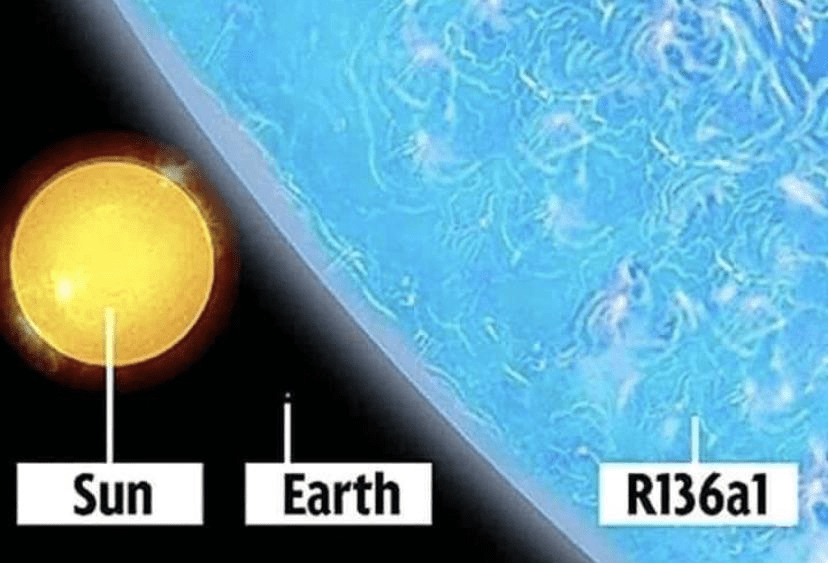
That title belongs to R136a1, a colossal blue star located in the Large Magellanic Cloud, about 165,000 light-years away.
This monster star:
- Shines nearly 8 million times brighter than the Sun
- Has a surface temperature of 56,000°C
- Weighs over 300 times as much as the Sun
- Is only 1.7 million years old
Because of its extreme heat, it’s losing mass at an astonishing rate—far faster than our Sun ever will.
The Smallest, the Largest, and the Extremes
At the opposite end of the scale are faint red dwarfs, barely glowing and impossible to see with the naked eye. Some are smaller than Jupiter and have surface temperatures of just 2,000°C.
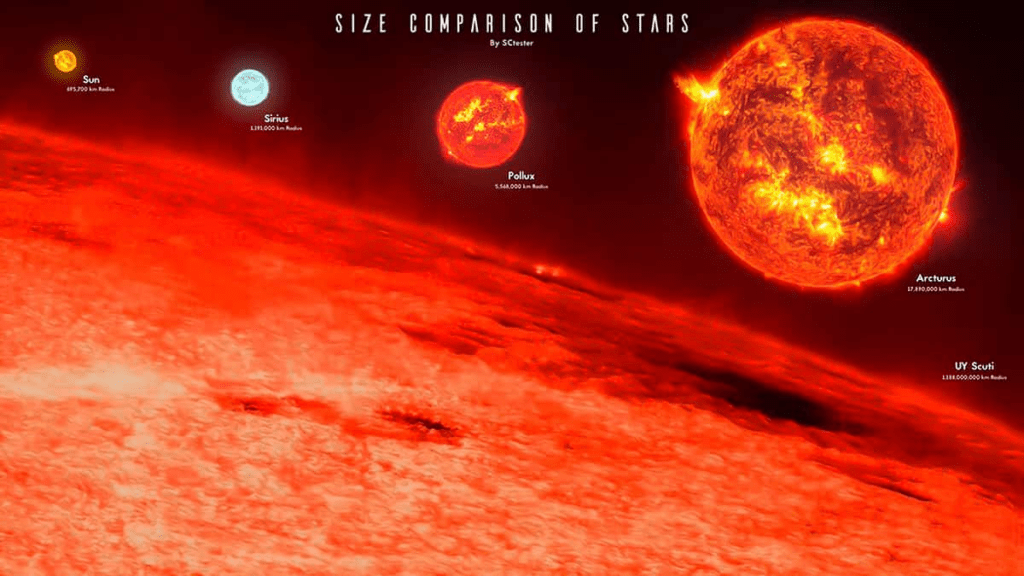
Then there are the giants.
For a long time, astronomers believed VY Canis Majoris was the largest known star. If placed in our Solar System, it would extend past Saturn’s orbit.
But later discoveries pushed the limits even further.
One of them is UY Scuti—currently considered the largest star ever observed. If Earth were the size of a volleyball, UY Scuti would tower like a mountain range.
Despite its enormous size, it’s surprisingly light—its density is lower than water. And one day, it too will explode as a supernova.
A Universe Still Waiting to Be Explored
All the stars we’ve talked about so far exist within—or near—our cosmic neighborhood. Beyond that lie billions of other galaxies, each filled with stars of their own.
What we know today may change tomorrow. New discoveries may reveal stars even larger, brighter, or stranger than anything we’ve seen so far.
And that’s what makes astronomy so fascinating.
I’m Jack, and this was just one step in our journey through the stars.
The universe is vast—and we’ve barely scratched the surface.