On February 23, 2017, NASA announced a discovery that immediately captured the world’s attention. Using space-based telescopes, scientists had identified a distant planetary system that might host life. Located about 40 light-years away, this system was quickly nicknamed “Solar System 2.0” because of how many similarities it shares with our own.
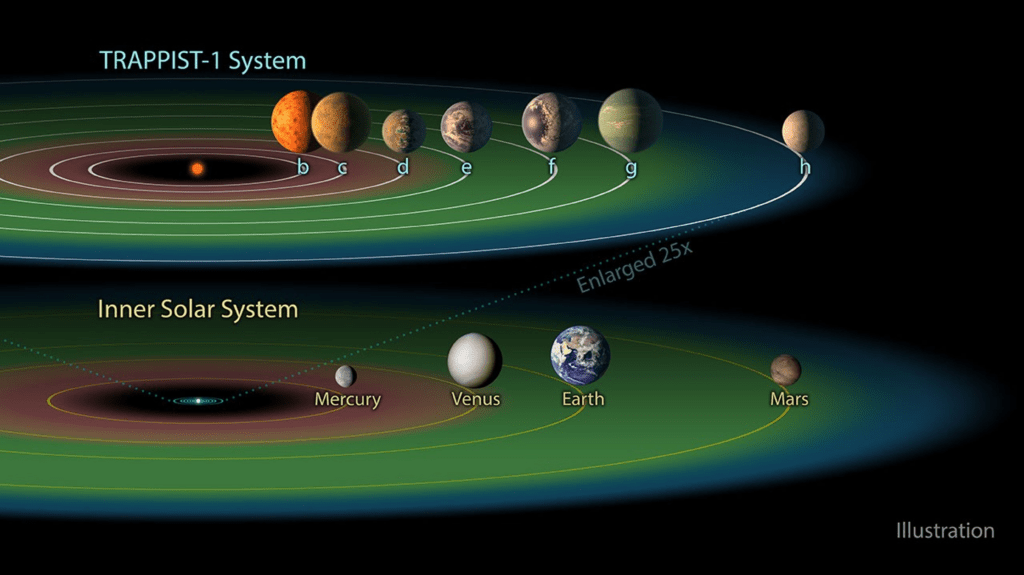
For the first time, humanity wasn’t just talking about a single Earth-like planet—but an entire system filled with rocky worlds, some of them sitting in regions where life could realistically exist.
This remarkable system lies in the constellation Aquarius and consists of seven planets orbiting a single small star. Several of these planets may have temperatures suitable for liquid water. And where there is liquid water, the possibility of life can no longer be ignored.
Meet the Star at the Center
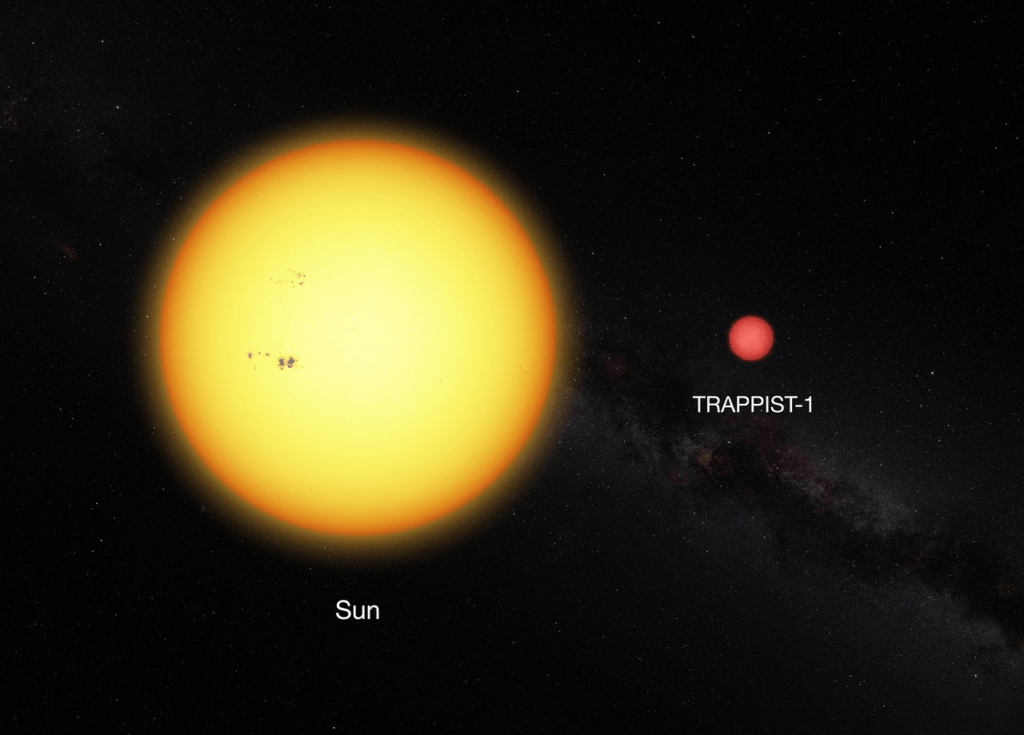
At the heart of this system is TRAPPIST-1, a red dwarf star with a surface temperature of only about 2,500°C—roughly half that of the Sun.
This star is small and lightweight:
- Mass: about 8% of the Sun
- Size: roughly 11% of the Sun, only slightly larger than Jupiter
Despite its modest size, TRAPPIST-1 has an incredibly long lifespan. While our Sun will burn out in a few billion years, this red dwarf could remain stable for trillions of years. Ironically, when our Solar System begins to fade, this distant system may only be entering its most stable era.
Traveling there with today’s technology would take around 800,000 years, making it far beyond our current reach—but not beyond our curiosity.
How the System Was Discovered
Before it gained its current name, TRAPPIST-1 was known by a long catalog designation that few could remember. In 2015, scientists at a Belgian university used the TRAPPIST telescope to study the star more closely and discovered three planets orbiting it.
Then, in 2016, further observations confirmed those planets, and the star officially received its new name: TRAPPIST-1.
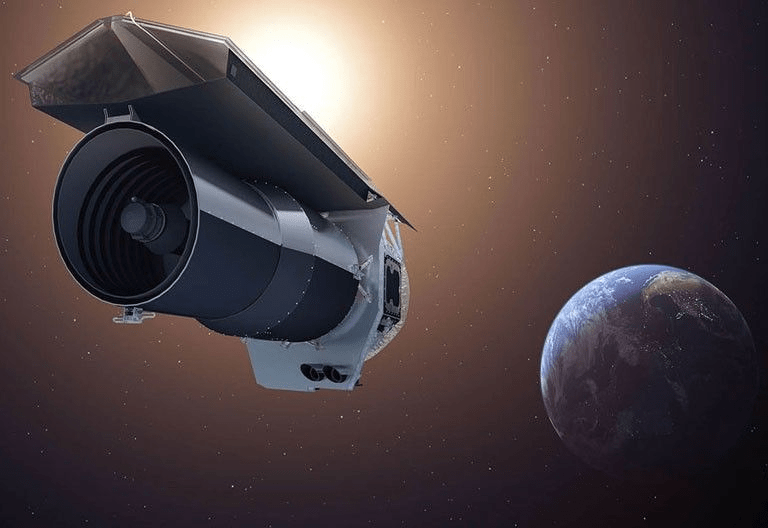
The real breakthrough came when NASA’s Spitzer Space Telescope—an infrared observatory launched in 2013—took a closer look. With its exceptional sensitivity to heat and infrared light, Spitzer detected seven planets orbiting this tiny star.
This discovery became one of the most important achievements in Spitzer’s long mission and a milestone in the search for life beyond Earth.
Seven Earth-Like Worlds, Packed Together
All seven planets in the TRAPPIST-1 system are believed to be rocky, with sizes surprisingly close to Earth’s. Only the outermost planet may be icy rather than rocky.
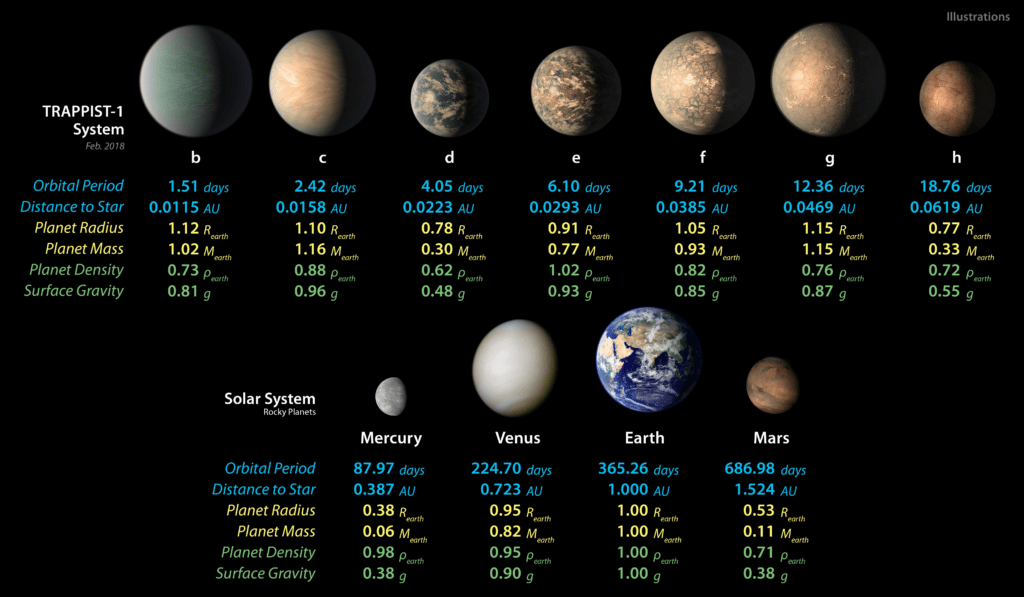
What makes this system truly unique is how compact it is. Every single planet orbits closer to its star than Mercury does to the Sun. From the surface of one planet, neighboring worlds could appear as visible disks in the sky—mountains and surface features potentially observable with the naked eye.
Because TRAPPIST-1 emits far less energy than the Sun, planets can orbit very close without being scorched. However, this closeness also creates unusual conditions:
- Strong gravitational interactions between planets
- Likely tidal locking, where one side of a planet always faces the star, while the other remains in permanent darkness
This means climates there could be radically different from anything we experience on Earth.
The Habitable Zone and the Most Promising Planets
Among the seven worlds, three planets lie within what scientists call the habitable zone—where temperatures could allow liquid water to exist.
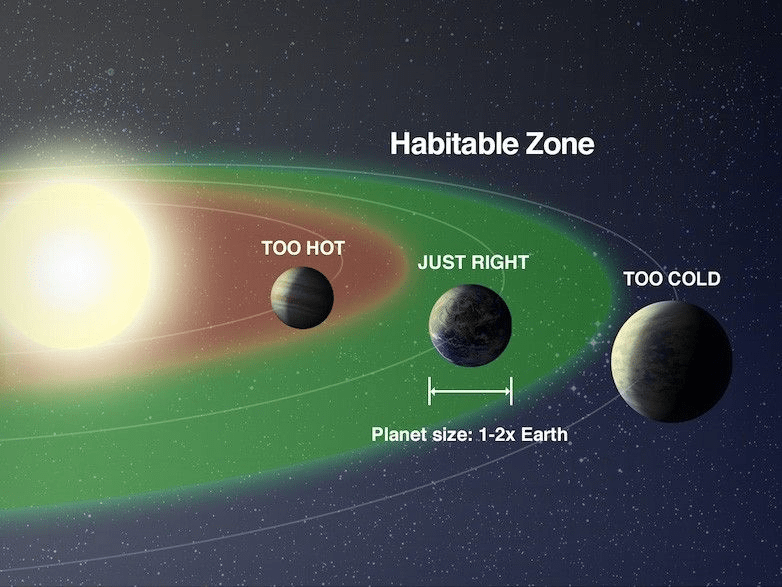
The most promising candidates are TRAPPIST-1d, TRAPPIST-1e, and TRAPPIST-1f. Of these, TRAPPIST-1e stands out as the most Earth-like in terms of the amount of energy it receives from its star.
If water exists on these planets—and the temperatures suggest it could—then the emergence of life would not be surprising at all. In fact, life might even arise on multiple planets within the same system.
If that turns out to be true, it would mean something profound: we are not alone, and life may be common throughout the universe.
What Comes Next?
For now, everything we know about TRAPPIST-1 comes from indirect observations. The next step is to analyze the atmospheres of these planets—looking for gases like oxygen, carbon dioxide, or even biological signatures.
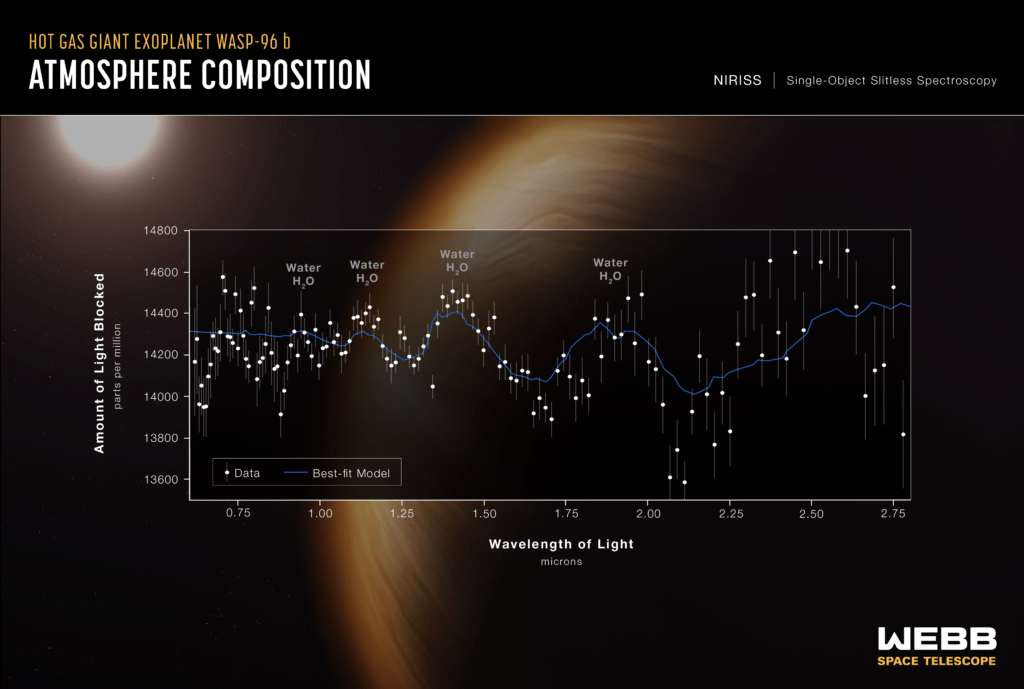
NASA’s future plans focused heavily on this system, especially with the launch of the James Webb Space Telescope, designed to study planetary atmospheres in unprecedented detail.
If scientists eventually confirm that this system is lifeless, it will still teach us invaluable lessons. But if even the simplest form of life is detected, it would be one of the greatest discoveries in human history—reshaping science, philosophy, and our vision of the future.
One day, traveling across dozens of light-years may no longer seem impossible. And when that day comes, systems like TRAPPIST-1 could become humanity’s next great destination.